How to Create an Online Supermarket

The Internet has been existing for more than 50 years. However, the revolution didn’t finish. We observe the huge impact of the Internet in every sphere. For example, there was a great rise of eCommerce stores within the last 5 years.
Nowadays, people may buy everything online from clothes to products. Food Marketing Institute reported the results of their latest survey about The Grocery Revolution. It showed that 43% of U.S. consumers order products online.
Online supermarkets seem to be the new trend. Probably, you have an idea of its creation but have no clue how to do it. How to start a grocery store online? How to choose the software? What features are obligatory? How much does it cost to start a grocery store?
There are so many questions. Yet we are here to give the answers and help you with eCommerce development.
Choose Your Business Model
The very first step is about defining the business plan for an eCommerce store. Why?
· it will help to organize delivery;
· it will be easier to define the target audience;
· you will find a better way to get profit.
There are three types of online supermarkets. The first is inventory-based. This business model implies the warehouse for online grocery. How does it work?
1. The customer places an order and makes payment.
2. You get the order details and share them with warehouse workers.
3. They fulfill customers’ orders and share them with the delivery service provided.
4. Finally, the order goes to the customer.
This model is mostly used by owners of brick-and-mortar stores to expand their marketing channels and get more customers. If you want to open a grocery store online from scratch, it is better to choose one of the following models.
The second type is the hyper-local eCommerce store. Here, you should become a partner with a local grocery store to fulfill orders. After the customer’s payment, you will share the order details with the local store. Thus, you aren’t responsible for the delivery and the quality of the products.
The third type is the marketplace model. It is similar to the previous concept. Yet in the second type, you will be a partner with one local store, while in this model you start a marketplace and allow different stores to create an account on your site.
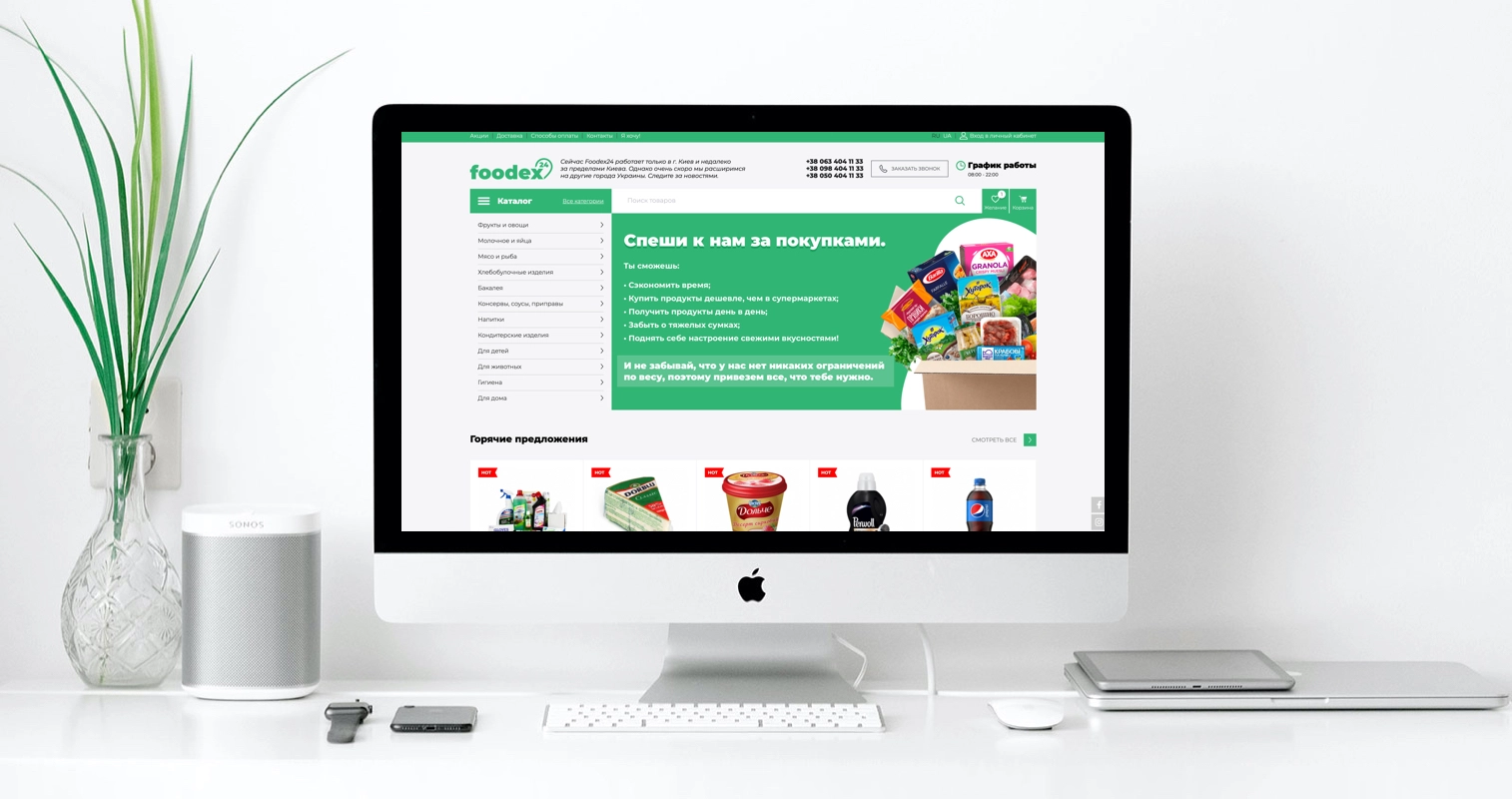
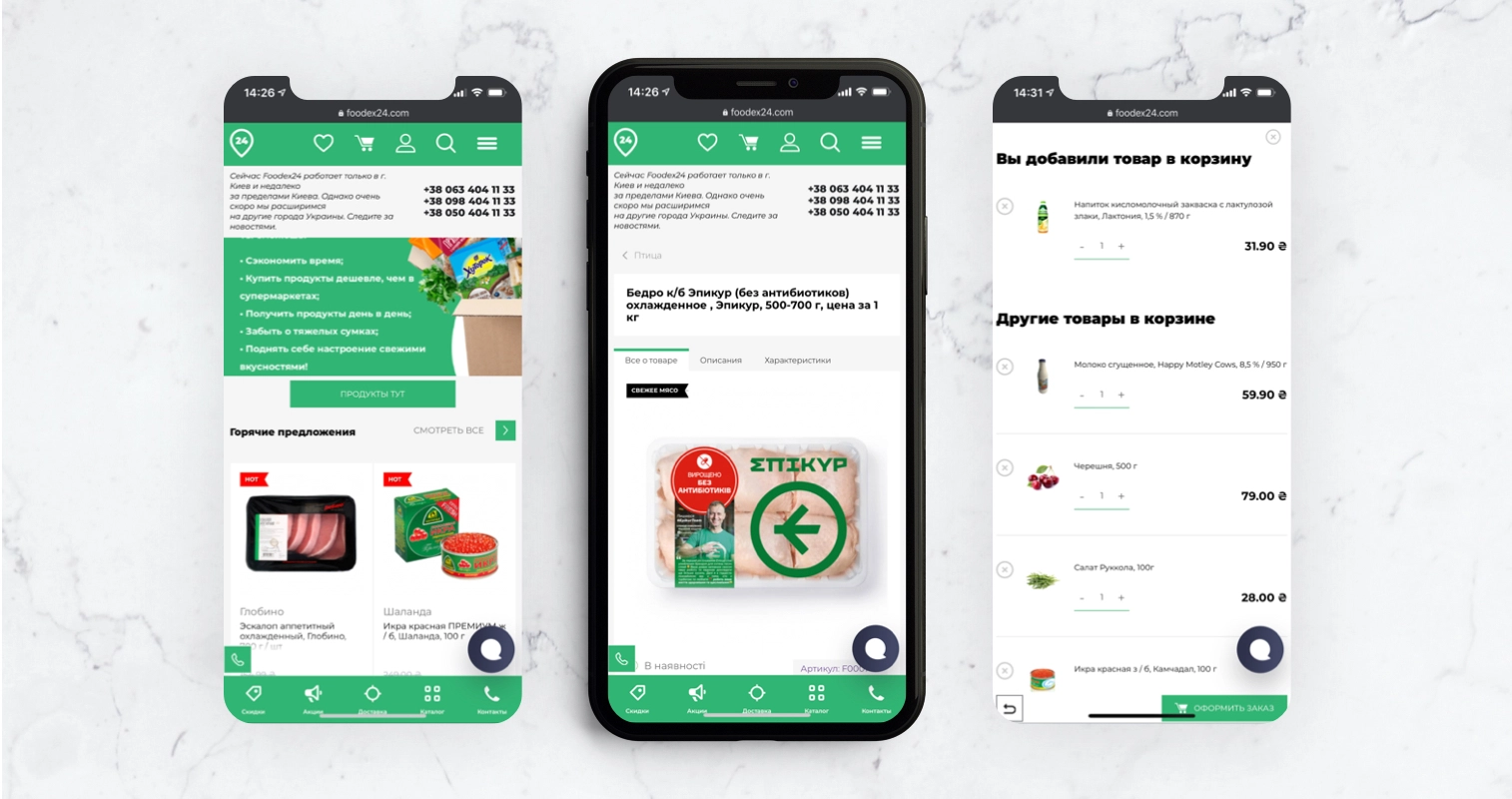
Or, you can forget the limits and do it the way Foodex24 did. Powercode developed an eCommerce website for Foodex24, which was also started by the founder and CEO at Powercode Vladyslav Savchenko. In contrast to the above-mentioned models, Foodex24 is an ultimate online supermarket with its own storage and delivery systems.
Define the Design
Design is one of the most important steps in eCommerce website development. It defines the future attitude of the customer to your service. Thus, you have to think of both the user interface and user experience.
While designing the UI, it is obligatory to consider the following:
· color scheme;
· fonts;
· size of blocks and images;
· white space;
· animations;
· background.
A Tip for Perfect Design
What is our recommendation? Make everything as simple as possible. Firstly, this makes your customer get the necessary information instantly. Secondly, this will provide greater page loading speed. Thus, your website will be good both for customers and search engines.
UX design is a more complex element. Here you have to develop such pages:
· registration and authorization;
· home screen;
· products list;
· cart;
· order history;
· product details.
Moreover, you have to develop the navigation panel, online support, search line, filters, and so on. The UX design should be easy to understand. If the customer has any problems, he will choose another online grocery. That is why we strongly recommend you to start such a business with the help of developers and designers experienced in eCommerce development for the food retail industry.
Think About Functions
Online supermarkets have some special functions like tracking the order and delivery status. This is mostly about integrating different APIs. We can do it in a few steps, but why do you need such functions?
Tracking. Customers of on-demand services want to get their order as fast as possible. In this case, they need an opportunity to control the order status to know whether it has been accepted or fulfilled. Moreover, it is compulsory to add map navigation so that your customers can track the delivery-man.
Payment. Sometimes we may observe companies with only one payment option (credit cards usually). It is ok for fashion brands, but not for online supermarkets. Why? Normally, they provide services locally. Thus, it is necessary to allow customers to pay via cash or via credit card after receiving the order.
Feedback. This is the best way of communicating with a customer. For instance, Amazon became successful, because they reply to every comment on their website. Moreover, feedback is a very good marketing point. The more positive feedback you get, the higher your site appears in search results.
Administrator panel. As you may have guessed, this is not for a customer. However, it is important for excellent service. This panel should:
· provide information about customers and their orders;
· allow to fulfill orders;
· check the products in stock;
· control revenue.
Delivery options. FMI report showed that clients don’t have the universal desire for delivery. That is why you have to add all opportunities:
-
home delivery via standard shipping;
-
BOPIS (buy online – pick-up in-store);
-
planned delivery;
-
ongoing delivery.
Choose the Stack
This stage is very important for web development. The appropriate technological stack is one of the key elements for high page loading speed and good UX design. Moreover, you have to remember about creating a mobile-friendly design. Some of the frameworks provide better opportunities for such developments.
Which back-end language? PHP. Although many developers don’t like this language, it is mostly used for eCommerce development. Thus, you will find enough tips and recommendations from professionals on forums and specialized online services like Github. Moreover, for server-side development you need:
-
a web server (usually Nginx or Apache);
-
Database (MySQL, PostgreSQL, MongoDB, DynamoDB etc);
-
hosting (normally for eCommerce developers use Amazon Web Services);
Which front-end language? Usually, developers use the stack of JavaScript, HTML and CSS for web-development and eCommerce development as well.
Which frameworks? There are many good instruments for web development. Yet today developers mostly use Zend or Laravel for back-end and React.js for front-end development.
Moreover, you need the following tools and integrations:
-
communicating with clients (SendGrid, Intercom etc);
-
payment processing (Paypal, Stripe etc);
-
warehouse management system (Mobe3, Infoplus etc);
-
ERP (Oracle, NetSuite etc);
-
shipping API (Shippo, Kyte.ly etc);
-
marketing and conversion (Google AdWords);
-
accounting management system (Quickbooks, Xero etc);
-
CRM (Salesforce, Zoho etc)
However, there is one more way to develop an online supermarket. You may use special platforms like WooCommerce, Shopify or OpenCart. Your site will be less unique rather than custom. Yet using such platforms is a cheaper and faster way to start an online grocery.
Add Products
Before launching a website and beginning the marketing stage, you have to add lots of products. You have to keep in mind that your service is positioned as a supermarket, so users may buy everything from food to shower stuff.
Here are some tips for adding goods:
-
Make a catalog.
-
Create descriptions with photos.
-
Allow comparing products with each other.
-
Be transparent about the composition and technical features.
-
Tell the expiry date.
According to the FMI report, Gen Z and Millenials want to get nutrition and health information and data beyond the package. Finally, think of what you usually check while buying goods in brick-and-mortar supermarkets. Add all of this information to the product description on your site.
How Much Does It Cost?
Some companies tell the approximate costs from 5 to 50 thousand dollars. You should not believe these prices for one reason. It is impossible to calculate the exact cost of any website without checking all the requirements.
Do you want to add user profile functions? What payment gateway will you choose? Do you need a chatbot? What types of support should be added? What do you want to add to the administrator panel apart from main options?
There are many factors that affect the cost. Thus, we can name a price after revising all of the details of your eCommerce store.
The Final Insight
After the development and registering the domain name, you have to register your business legally. Otherwise, your grocery store will be closed and you will have legal troubles. Next, you have to build your delivery team. It is necessary for them to speak local languages and have good communication skills.
Finally, the marketing stage. No one would get to know about your services without promotion. Think of e-mail campaigns, SMM, micro-influencers, banners, and so on. Just go and get it!