How to succeed in non technical jobs in tech: a roadmap to a beneficial career switch

Sofię_Nalimską
Project Manager
In today’s world, where many significant positive and not-so-positive events have recently taken place, people, more than ever, need faith in the future. Things that five years ago seemed monolithic and such that would remain for centuries are bursting at the seams and collapsing before our very eyes. The COVID-19 pandemic, global and local lockdowns, the change in the vector of economic, social, and political development, the first timid steps to get out of COVID-19, and the post-COVID realia are just a tiny part of what the world is facing. Add to this the Russian military aggression against Ukraine, which like a pendulum, launched a cycle of irreversible processes all over the world, for which people were not ready, both psychologically and physically, and we get a not-very rosy picture. The world community had an urgent need to adapt to the prevailing conditions. And many turned their attention to the IT sphere, which had been in great demand before all these events. The IT industry is one of the most stable and, most importantly, constantly developing and growing industries, which responds to all challenges with honor. For example, according to the
Information Technology Professional Demographics and Statistics in the US, the IT sector employs more than 279,000 professionals whose average age is 41 years old. In Ukraine, the demand for new specialists in IT is about 30-50 thousand people every year. However, many people are concerned about changing their positions without a technical background. Powercode has decided to devote several issues to the topic of non technical jobs in tech and how to properly build a non-tech IT career roadmap to alleviate suffering and inspire confidence in people and their abilities. All data and practical advice provided are based on our incredibly fantastic team members’ rich experience and success stories.
 Nowadays, you can see and hear this term everywhere, especially in materials related to the IT area. Imagination draws people to turn their heads around, looking for something they have never imagined and ready to jump into this unknown but beckoning place. But this is only partially true. A typical switcher is a person with experience and practical knowledge in one area who has decided to completely change the type of activity motivated by the desire to find a more promising sector for self-realization.
Conventionally, they can be divided into two categories:
Nowadays, you can see and hear this term everywhere, especially in materials related to the IT area. Imagination draws people to turn their heads around, looking for something they have never imagined and ready to jump into this unknown but beckoning place. But this is only partially true. A typical switcher is a person with experience and practical knowledge in one area who has decided to completely change the type of activity motivated by the desire to find a more promising sector for self-realization.
Conventionally, they can be divided into two categories:
 If you feel that you have reached a critical point and can no longer continue to move in the chosen direction, or external circumstances “shout” to you that it is time to change everything, or if you are afraid and do not believe that you can succeed and realize yourself in a completely new field, we hasten to assure you that this is not so. There are many examples of people starting from scratch and reaching the top in the IT field and beyond. Our unsurpassed commercial director Mykolai is a fabulous example! He gladly shared his story to inspire everyone to take decisive action. BRIEF DATA: Full name: Mykolai Brylenko. Education: higher technical. Additional education: Effective company, transformation of the organization according to the methodology of Adizes, 2018 Agile Scrum from scratch to Scrum Master, 2020 Career path: Sales Consultant, AMI – Store Director, AMI – Purchasing Manager, AMI – Product Manager for ELKO laptops – Head of Department, Rozetka – Development Director, Rozetka – Commercial Director in IT company
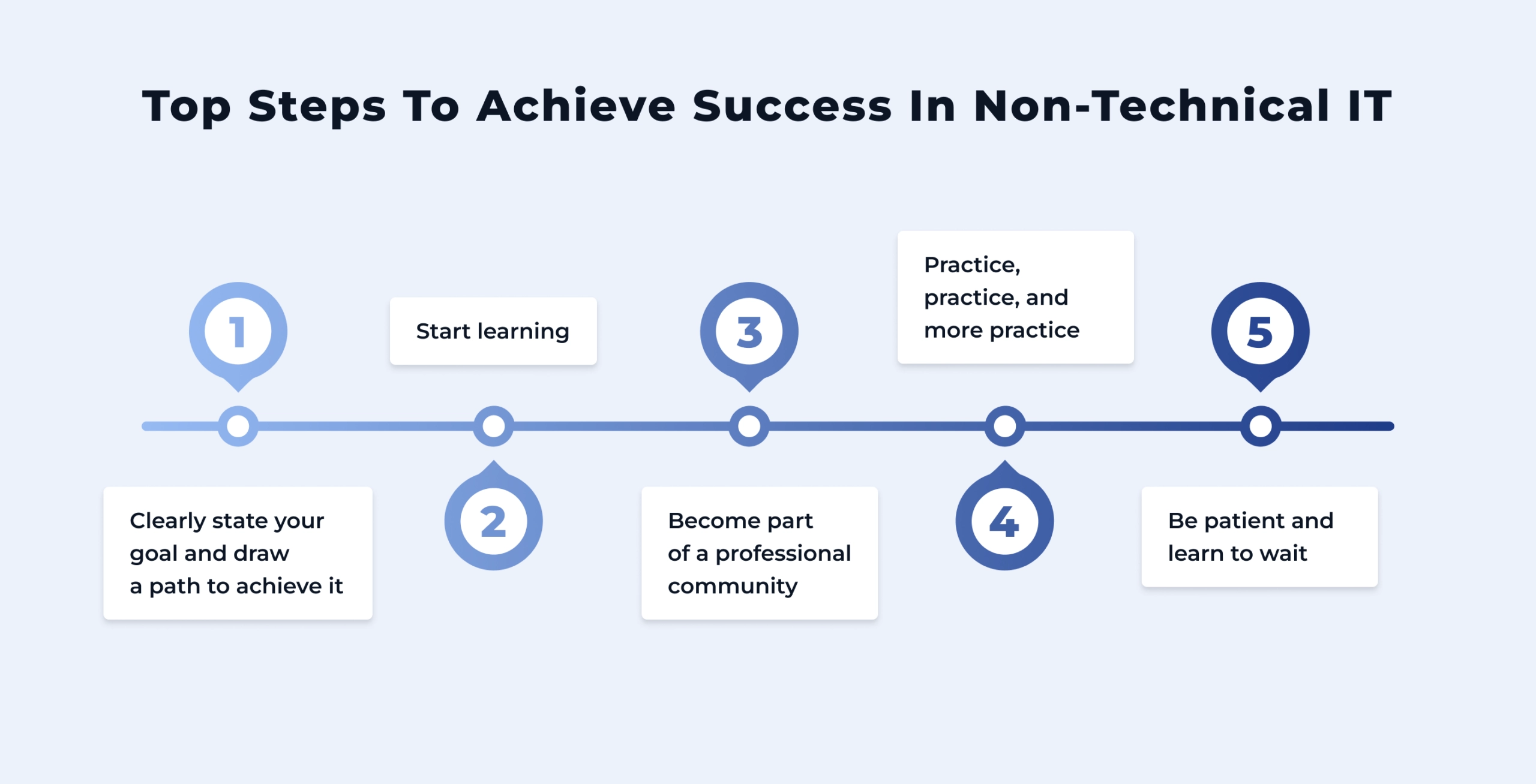
Based on Mykolai’s story, his tips, and pieces of advice provided by our other team members, now we will build a non-tech IT career roadmap to clearly show what steps are best taken to achieve the goal.
WHO IS THIS MYSTERIOUS SWITCHER?
Nowadays, you can see and hear this term everywhere, especially in materials related to the IT area. Imagination draws people to turn their heads around, looking for something they have never imagined and ready to jump into this unknown but beckoning place. But this is only partially true. A typical switcher is a person with experience and practical knowledge in one area who has decided to completely change the type of activity motivated by the desire to find a more promising sector for self-realization.
Conventionally, they can be divided into two categories:
- Representatives of working professions such as engineers, builders, architects, shoemakers, locksmiths, plumbers, etc., who are tired of working with their hands and want to earn no less, preferably, even more, using their heads.
- Office workers such as economists, accountants, lawyers, consultants, psychologists, philologists, teachers, and managers who want to be part of a rapidly developing modern industry with significant investments and excellent earning opportunities.
A FIRST-HAND SUCCESS STORY
If you feel that you have reached a critical point and can no longer continue to move in the chosen direction, or external circumstances “shout” to you that it is time to change everything, or if you are afraid and do not believe that you can succeed and realize yourself in a completely new field, we hasten to assure you that this is not so. There are many examples of people starting from scratch and reaching the top in the IT field and beyond. Our unsurpassed commercial director Mykolai is a fabulous example! He gladly shared his story to inspire everyone to take decisive action. BRIEF DATA: Full name: Mykolai Brylenko. Education: higher technical. Additional education: Effective company, transformation of the organization according to the methodology of Adizes, 2018 Agile Scrum from scratch to Scrum Master, 2020 Career path: Sales Consultant, AMI – Store Director, AMI – Purchasing Manager, AMI – Product Manager for ELKO laptops – Head of Department, Rozetka – Development Director, Rozetka – Commercial Director in IT company