Top Reasons Why Web 3.0 Will Benefit Your Business

Sofię_Nalimską
Project Manager
Decentralization, blockchain, DeFi, blockchain patch, NFT applications, DeFi marketing… We are sure you have heard or seen these terms at least once in the last few days. They have become part of the modern business world and have firmly taken root there. Someone may not like it; someone may look at them with caution. But it is simply impossible to ignore and not perceive the changes that web 3.0 development brings if your goal is to expand and conquer new heights. Our software development company specializes in a variety of robust decentralized solutions.
 The Web3 idea is associated with the name of Gavin Wood, a co-founder of Ethereum, who offered to create a decentralized Internet option utilizing blockchain technology and tokenization with control in the hands of users rather than industry giants. Its mission is to empower people to monitor their financial resources, personal data, NFT, and other valuable objects. Web3 also boosts security by distributing data around all the network’s nodes and storing it in the blockchain.
Some representatives of the business world community interchange these two concepts and do not see a significant difference between them. No matter what view a person takes, everyone agrees that they have considerable potential for development, especially by implementing blockchain and cryptocurrency technologies.
The Web3 idea is associated with the name of Gavin Wood, a co-founder of Ethereum, who offered to create a decentralized Internet option utilizing blockchain technology and tokenization with control in the hands of users rather than industry giants. Its mission is to empower people to monitor their financial resources, personal data, NFT, and other valuable objects. Web3 also boosts security by distributing data around all the network’s nodes and storing it in the blockchain.
Some representatives of the business world community interchange these two concepts and do not see a significant difference between them. No matter what view a person takes, everyone agrees that they have considerable potential for development, especially by implementing blockchain and cryptocurrency technologies.
 Semantic Web. The necessity for a machine to independently distinguish the semantic content of data, processing not only automatically entered keywords and concepts, has become one of the most crucial. The main task is to teach artificial intelligence to understand better the information entered on the network and present it intuitively.
Decentralized Data Network. Web 3.0’s predecessors had a centralized control system, and users were deprived of the ability to control their data. Now, by storing user data in a non-custodial identification wallet, the system allows people to have complete control over their digital information and manage it at their sole discretion. Decentralized networks guarantee users no control points.
Artificial Intelligence and Machine Learning. It is AI that is responsible for converting human-generated content into machine-readable data. It learns and self-improves to reduce and simplify the work necessary to develop a person and humanity. AI enables computers to distinguish and understand information like people. A striking example is chatbots that conduct dialogues on an equal basis with humans. Also, when working with huge collections of statistical data, it is preferable to use ML since it could be challenging or time-consuming to identify dependencies using conventional or customized methodologies.
Openness and Shared Ownership. Web3 technologies’ decentralized nature guarantees enhanced transparency and accountability. Users will have the right to share their data with whomever they want and when they want. The risk of corruption is significantly reduced because all parties involved can quickly and effortlessly verify the essential data, including transaction histories and smart contract specifications.
Accessibility. The number and variety of devices connected to the Internet and working with Web 3.0 are constantly growing, thereby making any information more accessible to more consumers at any place and time. For example, IoT technology allows people to quickly access frequently-updated information in real time, even when they are far away from their actual location. It also connects and enables electric devices to communicate with a controller unit.
Credibility. Blockchain technologies’ encryption and protection prevent big players like corporations from using other people’s data for their own purposes. New technologies can also improve security by continuously tracking digital and physical infrastructures and gathering information from nearby computers and hardware systems. Specialists can programmatically plan various system modifications to prevent unwanted data breaches and hacks using these steps.
Ubiquity. Decentralized servers make systems accessible from everywhere, which reduces reliance on large technologies like those used in Web 2.0. Web 3.0 vastly expands the opportunities for user interaction with data by becoming more platform and device neutral. No matter what devices you use, mobile phones, desktop computers, automobiles, or sensors, you will always have access to your data.
Semantic Web. The necessity for a machine to independently distinguish the semantic content of data, processing not only automatically entered keywords and concepts, has become one of the most crucial. The main task is to teach artificial intelligence to understand better the information entered on the network and present it intuitively.
Decentralized Data Network. Web 3.0’s predecessors had a centralized control system, and users were deprived of the ability to control their data. Now, by storing user data in a non-custodial identification wallet, the system allows people to have complete control over their digital information and manage it at their sole discretion. Decentralized networks guarantee users no control points.
Artificial Intelligence and Machine Learning. It is AI that is responsible for converting human-generated content into machine-readable data. It learns and self-improves to reduce and simplify the work necessary to develop a person and humanity. AI enables computers to distinguish and understand information like people. A striking example is chatbots that conduct dialogues on an equal basis with humans. Also, when working with huge collections of statistical data, it is preferable to use ML since it could be challenging or time-consuming to identify dependencies using conventional or customized methodologies.
Openness and Shared Ownership. Web3 technologies’ decentralized nature guarantees enhanced transparency and accountability. Users will have the right to share their data with whomever they want and when they want. The risk of corruption is significantly reduced because all parties involved can quickly and effortlessly verify the essential data, including transaction histories and smart contract specifications.
Accessibility. The number and variety of devices connected to the Internet and working with Web 3.0 are constantly growing, thereby making any information more accessible to more consumers at any place and time. For example, IoT technology allows people to quickly access frequently-updated information in real time, even when they are far away from their actual location. It also connects and enables electric devices to communicate with a controller unit.
Credibility. Blockchain technologies’ encryption and protection prevent big players like corporations from using other people’s data for their own purposes. New technologies can also improve security by continuously tracking digital and physical infrastructures and gathering information from nearby computers and hardware systems. Specialists can programmatically plan various system modifications to prevent unwanted data breaches and hacks using these steps.
Ubiquity. Decentralized servers make systems accessible from everywhere, which reduces reliance on large technologies like those used in Web 2.0. Web 3.0 vastly expands the opportunities for user interaction with data by becoming more platform and device neutral. No matter what devices you use, mobile phones, desktop computers, automobiles, or sensors, you will always have access to your data.
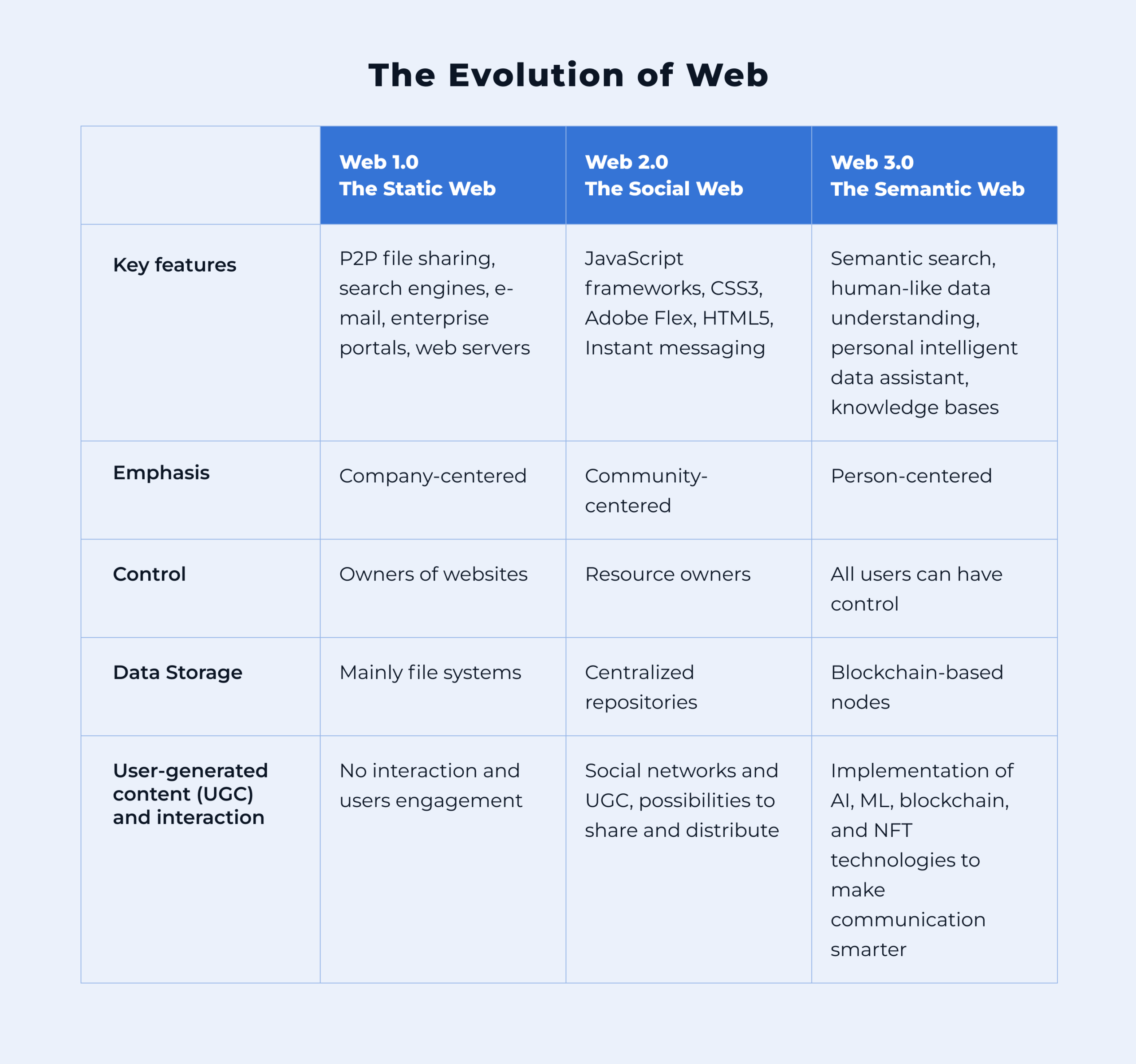
The Evolution of Web
What is behind these sensational Web 3.0 or Web3?
  “The real potential of Web3 is in allowing businesses and people
to collectively function more similarly to biological ecosystems.”
Hendrith Vanlon Smith Jr, CEO of Mayflower-Plymouth
Too much hype and controversy go around these terms. Someone equates them, someone strongly disagrees, and someone intelligently remains silent. So, are they the same or different? We will provide you with facts and different points of view, and you will decide for yourself.
The Web 3.0 concept primarily implies large-scale changes in the person’s interaction with the environment enabling the first to hold some digital assets. Tim Berners-Lee, WWW’s mastermind and developer, initially identified it as the Semantic Web, the main task of which was to conceptualize and contextualize the content relying on AI and/or machine learning. It emphasizes effectiveness and knowledge. Unlike Web 2.0, which works on principles of user engagement in content creation and centralized data storage on servers, Web 3.0 provides users with more freedom and transparency by implementing distributed ledger technology and a semantic architecture.
The Web3 idea is associated with the name of Gavin Wood, a co-founder of Ethereum, who offered to create a decentralized Internet option utilizing blockchain technology and tokenization with control in the hands of users rather than industry giants. Its mission is to empower people to monitor their financial resources, personal data, NFT, and other valuable objects. Web3 also boosts security by distributing data around all the network’s nodes and storing it in the blockchain.
Some representatives of the business world community interchange these two concepts and do not see a significant difference between them. No matter what view a person takes, everyone agrees that they have considerable potential for development, especially by implementing blockchain and cryptocurrency technologies.
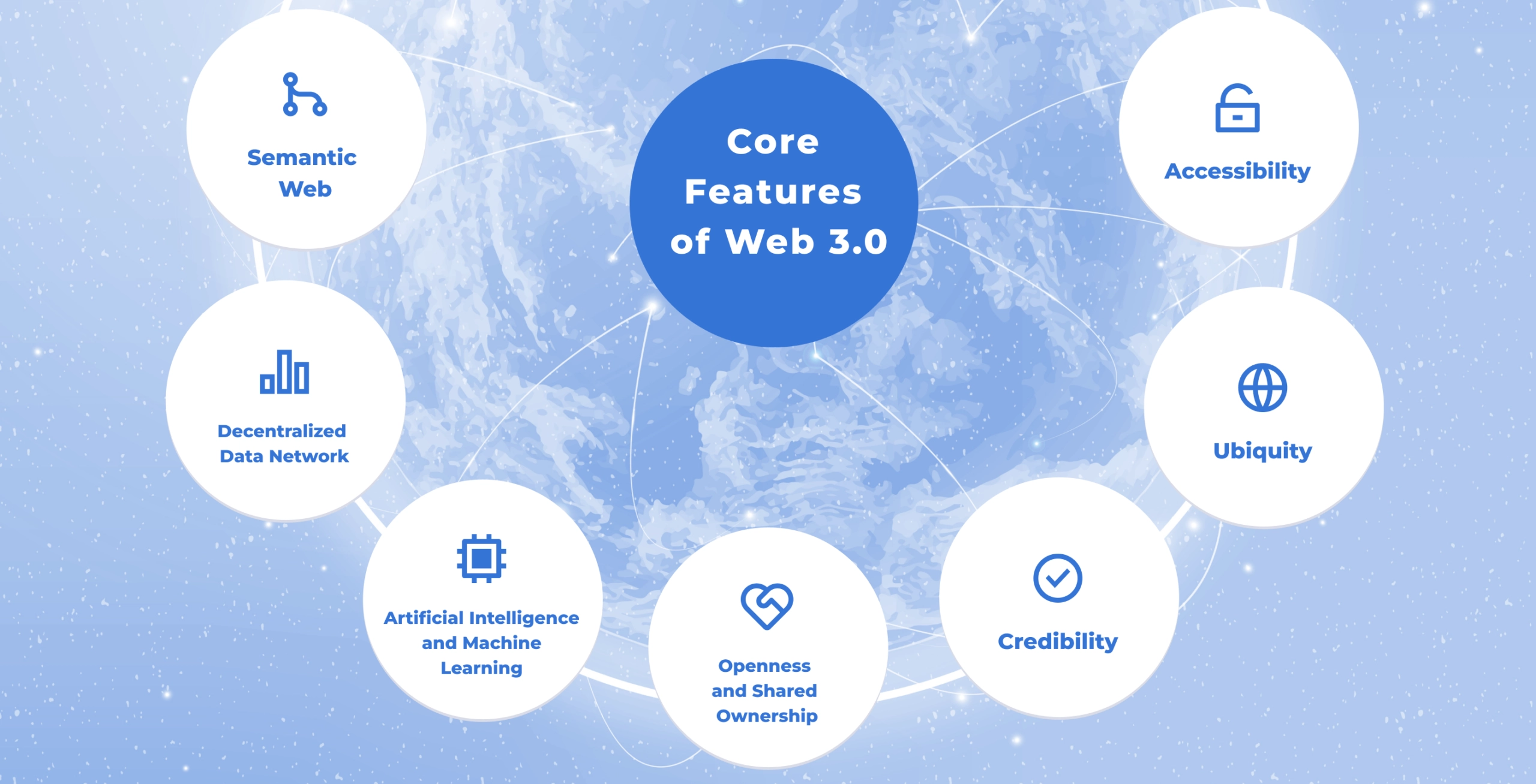
The Core Functionality of Web 3.0
Semantic Web. The necessity for a machine to independently distinguish the semantic content of data, processing not only automatically entered keywords and concepts, has become one of the most crucial. The main task is to teach artificial intelligence to understand better the information entered on the network and present it intuitively.
Decentralized Data Network. Web 3.0’s predecessors had a centralized control system, and users were deprived of the ability to control their data. Now, by storing user data in a non-custodial identification wallet, the system allows people to have complete control over their digital information and manage it at their sole discretion. Decentralized networks guarantee users no control points.
Artificial Intelligence and Machine Learning. It is AI that is responsible for converting human-generated content into machine-readable data. It learns and self-improves to reduce and simplify the work necessary to develop a person and humanity. AI enables computers to distinguish and understand information like people. A striking example is chatbots that conduct dialogues on an equal basis with humans. Also, when working with huge collections of statistical data, it is preferable to use ML since it could be challenging or time-consuming to identify dependencies using conventional or customized methodologies.
Openness and Shared Ownership. Web3 technologies’ decentralized nature guarantees enhanced transparency and accountability. Users will have the right to share their data with whomever they want and when they want. The risk of corruption is significantly reduced because all parties involved can quickly and effortlessly verify the essential data, including transaction histories and smart contract specifications.
Accessibility. The number and variety of devices connected to the Internet and working with Web 3.0 are constantly growing, thereby making any information more accessible to more consumers at any place and time. For example, IoT technology allows people to quickly access frequently-updated information in real time, even when they are far away from their actual location. It also connects and enables electric devices to communicate with a controller unit.
Credibility. Blockchain technologies’ encryption and protection prevent big players like corporations from using other people’s data for their own purposes. New technologies can also improve security by continuously tracking digital and physical infrastructures and gathering information from nearby computers and hardware systems. Specialists can programmatically plan various system modifications to prevent unwanted data breaches and hacks using these steps.
Ubiquity. Decentralized servers make systems accessible from everywhere, which reduces reliance on large technologies like those used in Web 2.0. Web 3.0 vastly expands the opportunities for user interaction with data by becoming more platform and device neutral. No matter what devices you use, mobile phones, desktop computers, automobiles, or sensors, you will always have access to your data.
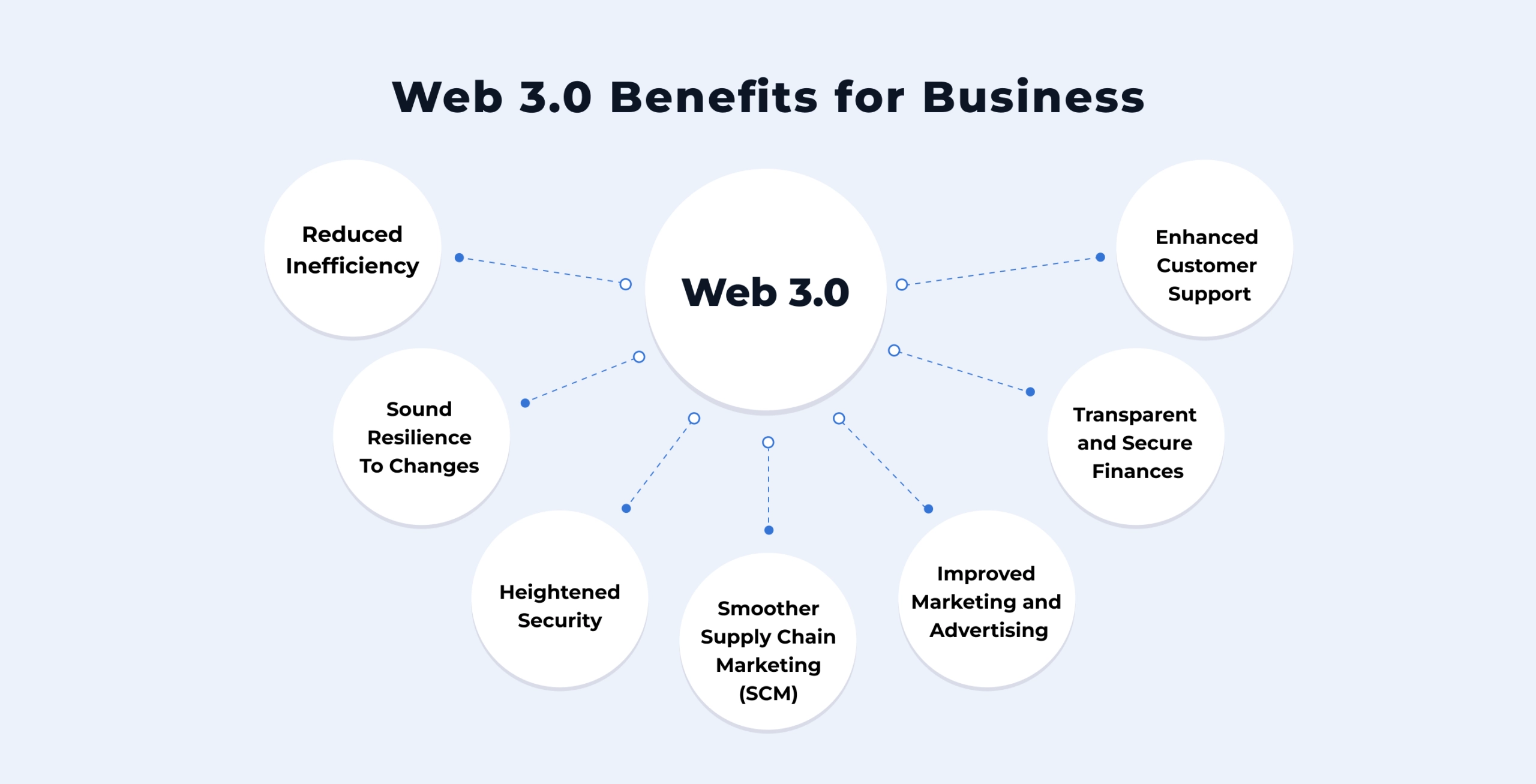
Web 3.0 Benefits for Business
“The power and advantages of decentralization are becoming increasingly clear.
We deserve a financial system where no one can be censored or excluded
from full participation.”
Silvio Micali, Founder, Algorand