How to Choose a Computer Vision Development Company
Choosing a computer vision development company is difficult because a convincing demonstration proves very little about production performance. A model can work on curated images and fail when lighting, camera position, product mix, weather, or operator behavior changes.
The right partner starts with an operational decision and a measurable business result. It then designs the data, model, hardware, software, monitoring, and human workflow as one system. This guide shows how to evaluate that capability without relying on a generic list of “top computer vision companies.”
Define the decision before selecting the model
Start with the action the system will support. “Detect defects” is incomplete. Define which defects, on which products, at what production speed, and what should happen after a detection. Specify the cost of a false positive, false negative, delayed result, and system outage.
Common applications include quality inspection, inventory monitoring, document processing, workplace safety, medical imaging support, visual search, and traffic analysis. The AWS overview of computer vision distinguishes tasks such as image classification, object detection, segmentation, and optical character recognition. The correct task depends on the business decision, not the popularity of a model.
Write a one-page use-case contract before requesting proposals:
- the user and operational decision;
- the input source, environment, and expected variation;
- the required output and response time;
- the cost of each error type;
- the human review or fallback path;
- the business metric and baseline.
Evaluate the data strategy first
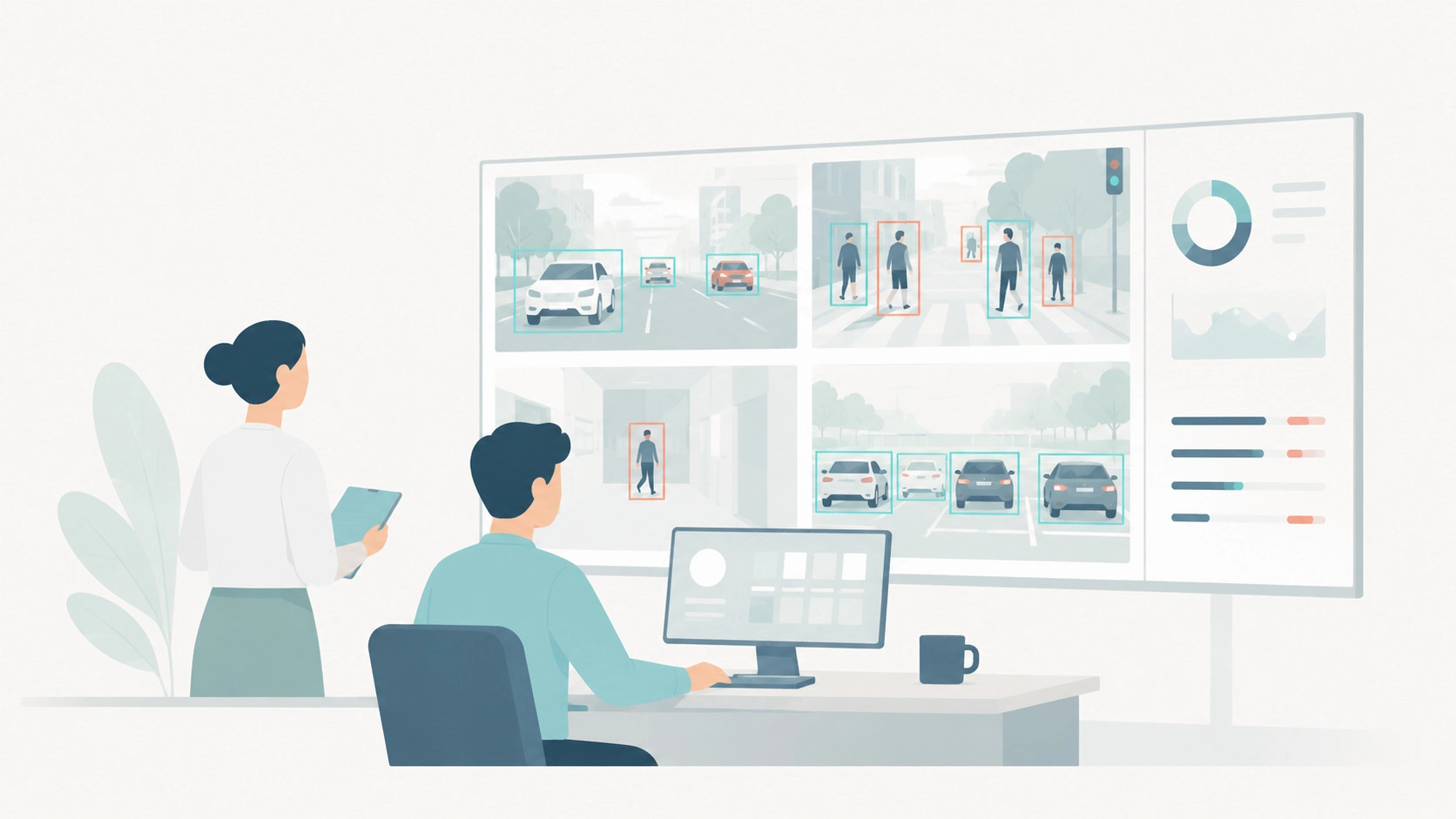
Data determines whether the system represents reality. Ask how the company will sample locations, devices, seasons, shifts, users, and edge cases. A large dataset can still be biased if it repeats the same easy conditions.
Ownership and permission
Confirm who may collect, label, store, transfer, and reuse each image or video. Define retention, deletion, access, and geographic restrictions. If people appear in the data, complete privacy and legal review before collection. Contract language should state who owns raw data, annotations, trained artifacts, evaluation sets, and improvements.
Label quality and versioning
Document label definitions with positive, negative, ambiguous, and out-of-scope examples. Measure agreement between annotators and review disputed cases with domain experts. Version datasets and labels so a model result can be reproduced.
Representative evaluation
Keep a test set that reflects real deployment conditions and is not used for training decisions. Segment results by site, device, product, lighting, and other meaningful groups. A single aggregate accuracy number can hide a dangerous failure mode.
Powercode’s AI and data science services can help design the data and evaluation pipeline when the main risk sits upstream of model training.
Use production metrics, not demo accuracy
Ask the computer vision software company to connect model metrics to operational cost. Depending on the task, useful measures may include precision, recall, false-positive rate, false-negative rate, intersection over union, mean average precision, latency, throughput, and abstention rate.
| Question | Why it matters | Evidence to request |
|---|---|---|
| Which error is more costly? | It determines thresholds and workflow | A cost matrix approved by the business owner |
| How does performance vary? | Aggregate metrics hide weak segments | Results by site, device, class, and condition |
| What happens below confidence? | Some cases need human review | An abstention and escalation policy |
| What is the end-to-end latency? | Model speed is only one component | Measurements on target hardware and network |
| How is drift detected? | The environment changes after launch | Monitoring thresholds and response runbook |
Do not demand a universal accuracy threshold. A safety alert and a catalog tagging tool have different tolerances. Acceptability comes from the cost of errors and the design of the surrounding process.
Assess the entire production architecture
A production solution includes cameras or scanners, lighting, mounts, device management, networking, edge or cloud compute, APIs, storage, user interfaces, observability, and support. The partner should explain failure behavior for each critical component.
Edge, cloud, or hybrid
Edge inference can reduce latency and data transfer and support disconnected operation. Cloud inference can simplify centralized deployment and scale. A hybrid design may process sensitive or time-critical data locally while centralizing model management and approved samples. Compare total cost, update process, security, and supportability rather than choosing from fashion.
Integration and fallback
Define how results enter the business system and who acts on them. Use idempotent interfaces, timestamps, traceable model versions, and clear retry behavior. If the model or camera fails, operations need a degraded mode, manual process, or safe stop.
Security and privacy
Review device identity, encryption, network segmentation, access control, patching, audit logs, supply-chain dependencies, and incident response. Apply the risk-management logic of the NIST AI Risk Management Framework to the full system, not only the model.
Check whether the team can operate the model
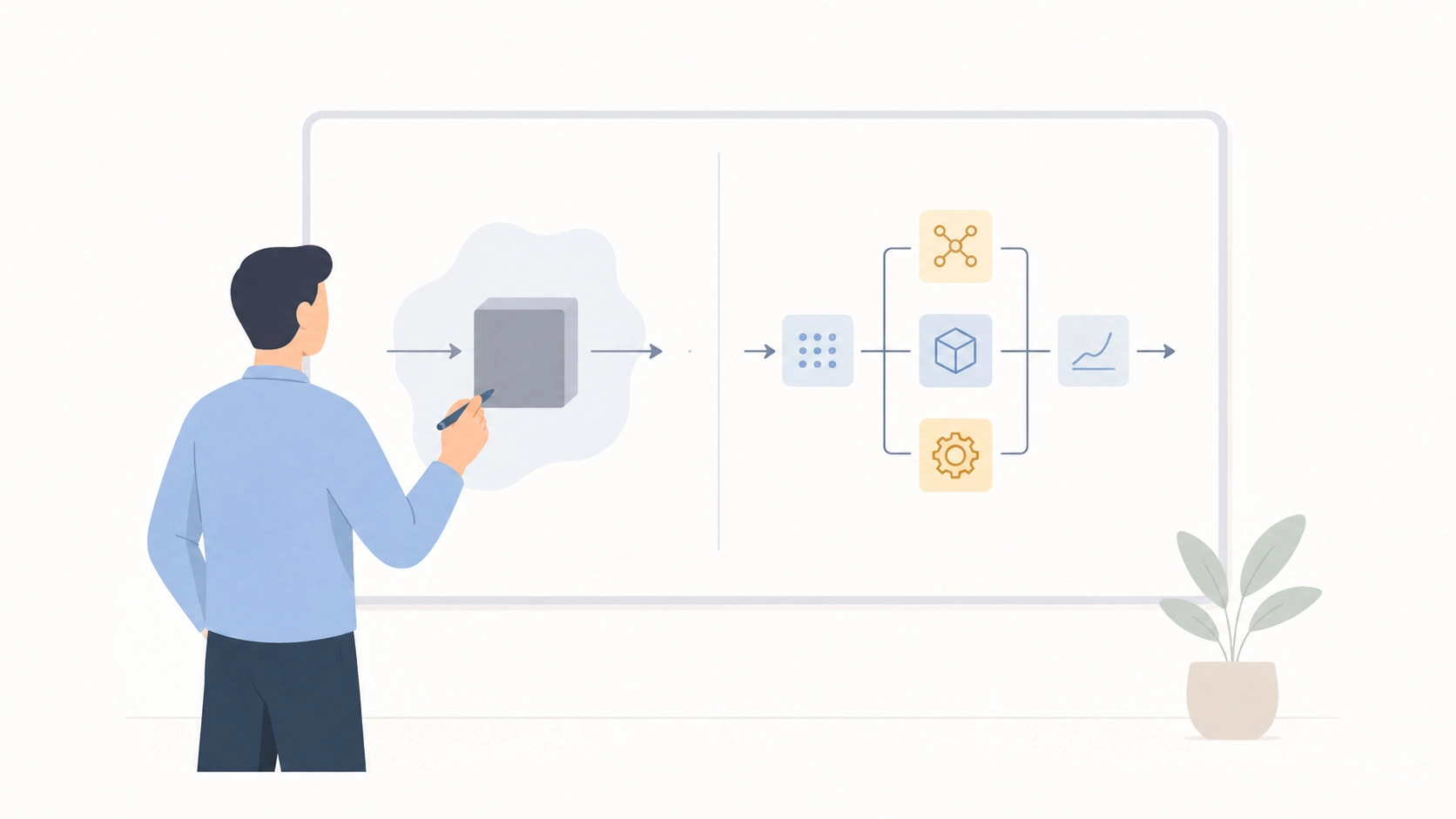
The strongest computer vision development companies plan for production changes before launch. Ask how they will detect input drift, performance degradation, camera movement, blocked lenses, missing frames, and changes in class distribution. Monitoring should combine system health, data quality, model behavior, and business outcomes.
Require versioned code, configuration, datasets, model artifacts, evaluation results, and deployment records. Releases need automated tests, staged rollout, rollback, and clear approval. The team should define how new samples enter a retraining process and who authorizes promotion.
If you are building this capability internally, our guide to hiring an ML engineer explains the production skills to assess beyond model development.
Run a production-shaped pilot
A pilot should reduce the most important uncertainty. It should use representative data and target hardware, integrate with a real workflow, and run long enough to observe meaningful variation. Avoid a polished demo built from a small hand-selected dataset.
- Discovery: validate the decision, baseline, constraints, data rights, and error costs.
- Feasibility: test representative samples and compare a simple baseline with candidate methods.
- Pilot: deploy at limited scope with real operators, monitoring, and fallback.
- Scale decision: compare business impact, model behavior, operational burden, and total cost against exit criteria.
A proof-of-concept development team can help structure this stage, but the deliverable must include evidence and a scale plan rather than only a visual demonstration.
Compare commercial models and total cost
Computer vision projects can use a product, a configurable platform, custom development, or a combination. Include cameras, edge devices, connectivity, labeling, model development, integration, cloud use, monitoring, support, retraining, security, and site rollout in the total cost.
A product is often efficient for a common, well-supported use case. Custom machine learning development makes more sense when the data, workflow, constraints, or competitive value are specific. Verify export options, API limits, model and data ownership, termination support, and the cost of changing providers.
A scorecard for selecting a computer vision company
Score candidates against the same evidence-based criteria. Weight the criteria before reviewing proposals.
- Use-case understanding: can the team translate operations into measurable model and workflow requirements?
- Data discipline: is sampling, labeling, privacy, versioning, and evaluation credible?
- Production engineering: can it integrate hardware, software, cloud or edge infrastructure, and observability?
- Delivery evidence: can it show comparable systems and explain failures and lessons?
- Ownership: are artifacts, access, documentation, and handover explicit?
- Commercial clarity: are assumptions, exclusions, support, and change control visible?
Where Powercode fits
Powercode is a fit when the problem needs custom computer vision integrated with a web, mobile, cloud, or enterprise product, and the client can provide domain access and representative data. We can cover product discovery, model work, software engineering, deployment, monitoring, and handover.
We are less suitable when a proven off-the-shelf product already meets the requirement, when no lawful path to representative data exists, or when the requested outcome cannot be measured. In those cases, more custom development will not fix the underlying constraint.
Frequently asked questions
How do I compare computer vision AI companies?
Compare their evidence for your environment: data strategy, segmented evaluation, production architecture, monitoring, security, ownership, and measurable business results. A general ranking cannot account for these constraints.
What should a computer vision pilot include?
It should use representative data and target hardware, connect to a real workflow, measure error costs and operational impact, include fallback, and define scale or stop criteria before work starts.
Should computer vision run at the edge or in the cloud?
Choose from latency, connectivity, privacy, data transfer, fleet management, scale, and cost. Many production systems use a hybrid design.
Who owns the model and training data?
The contract should state ownership and permitted use for raw data, labels, code, model artifacts, evaluation sets, and improvements. It should also define export and transition support.
What is the difference between machine vision and computer vision?
Computer vision is the broader field of extracting information from images or video. Machine vision commonly refers to an engineered industrial system that combines imaging hardware, controlled conditions, software, and automation.