Hire AI Developers: Choose the Role, Scope and Budget
To hire AI developers, start with the work your product needs: integrating an existing model, building an application around it, training a model, improving data pipelines or deploying a system into a customer workflow. Then choose the role, define what your team retains and assess evidence from a representative task. “AI developer” is a useful search term, but it is too broad for a role brief.

For a founder or CTO in a small team, the immediate question is where delivery is blocked. If a clear feature needs implementation, additional engineering capacity may fit. If the user problem, usable data or acceptance decision is still unresolved, define that work before requesting profiles.
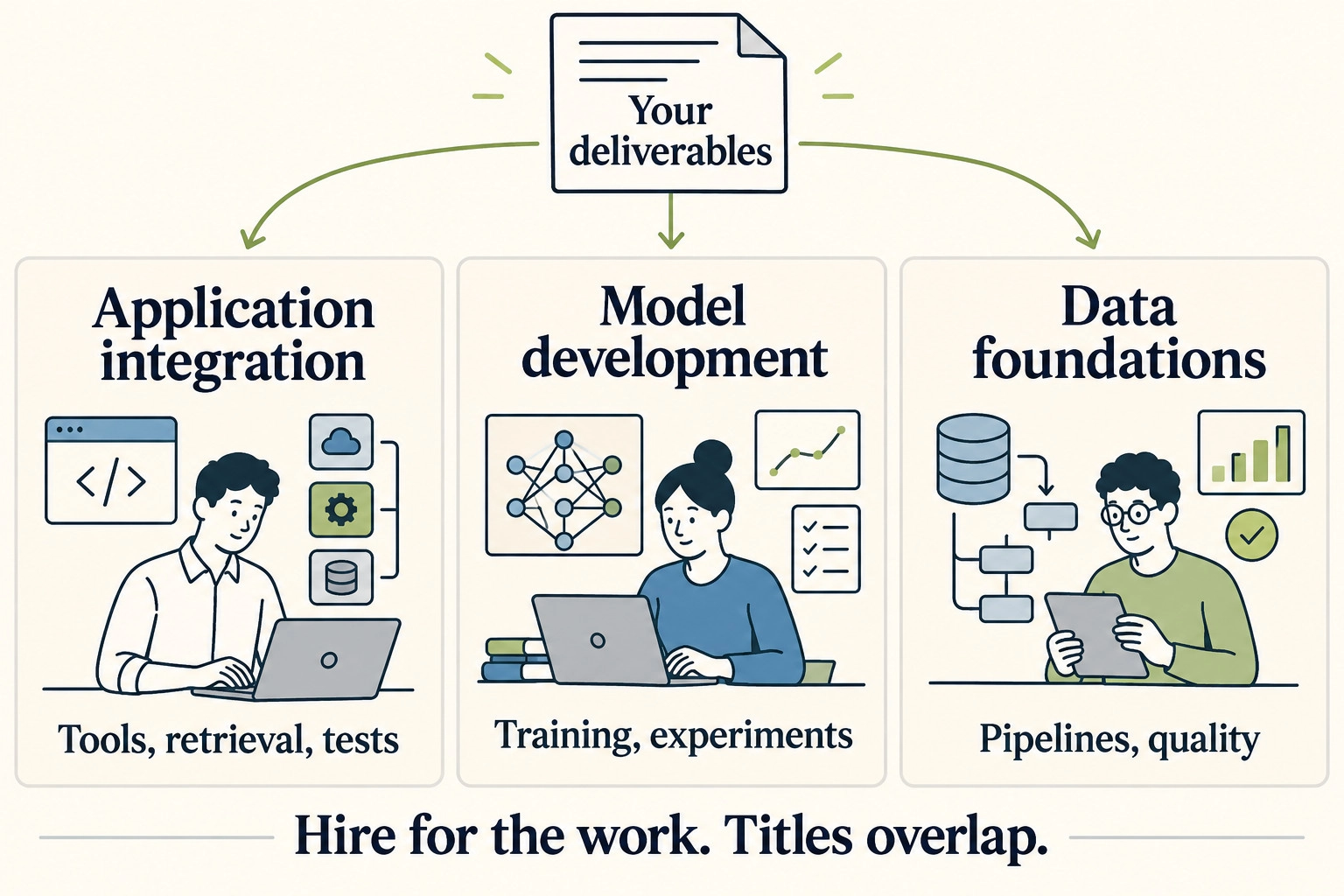
Match the AI role to the missing capability
| Your need | Role to assess | Evidence to request |
|---|---|---|
| Add an existing model to a product workflow | AI application or software engineer | Application integration, access controls, failure handling and deployment |
| Build retrieval, model tools or an LLM application | LLM engineer | Retrieval boundaries, tool permissions and task-specific evaluations |
| Train, adapt or operate a predictive model | ML engineer | Data reasoning, validation, reproducibility and production monitoring |
| Make operational data usable and reliable | Data engineer | Pipelines, data quality, lineage and recoverable processing |
| Move a system through a customer’s integrations and rollout | Deployment-focused engineer or embedded delivery role | Workflow discovery, implementation, release ownership and handover |
These responsibilities can overlap in one person. Decide which are essential for the first work package and which already have an owner. For a deeper existing-model application brief, use our LLM engineer hiring guide. For training and production-model responsibilities, see how to evaluate an ML engineer.
Describe the first useful task before listing frameworks
Write a short brief with the user, workflow, current system and accepted result. Name the data and integrations the engineer can access. Add the person who will set priorities, review changes and accept the work. A framework preference becomes useful when it follows from those constraints.
For example, imagine a SaaS team adding assistance to support-ticket triage. The first task might be suggesting a category for a human agent to approve. A useful brief would identify the available ticket fields, restricted customer information, categories and review process. It would also define what happens when the suggestion is uncertain or wrong.
That brief gives candidates something concrete to discuss: the application boundary, information access, evaluation and a controlled release. It also lets you ask whether a simpler workflow would solve the problem. Anthropic’s guidance on building effective agents recommends starting simply and adding complexity when needed.
Assess the decisions behind the demonstration
Ask a candidate to explain a small, clearly hypothetical change using sanitised information. Agree the assessment format and permitted AI tools in advance. Use the same criteria for every candidate, and leave production access outside the exercise.
- Problem judgement: can they narrow the task and explain where AI adds value?
- Engineering: can they describe integration, error handling, tests and deployment?
- Information boundaries: can they identify what each user may retrieve or change?
- Evaluation: can they define useful test cases and interpret failures?
- Handover: can another engineer understand and maintain the result?
OpenAI’s evaluation guidance supports task-specific tests, human calibration and continued evaluation as an application changes. Ask for the candidate’s reasoning and implementation choices. Our developer assessment guide helps turn those requirements into a bounded exercise.
Make failure handling part of the brief
Ask who decides when output needs human approval, what the application records and how a change can be reversed. For a system that writes to customer records, define which actions need approval and how you will check the resulting state. For a read-only assistant, focus on source access, answer quality and the user’s next step.
Use representative tasks to compare the proposed behaviour before expanding the work. Keep the approved cases, failures and unresolved decisions with the release record. Our agent evaluation guide explains that evidence in more detail.
For remote sourcing channels and the recruitment process across QA and AI/ML roles, use our remote engineering hiring guide.
Where can you hire AI developers?
You can hire directly, use an individual engineer through a staffing partner, or engage a supplier-led team. Choose an individual hire or supplied capacity when your team can direct the work and make product and technical decisions. Consider a coordinated team when several disciplines need shared ownership. Put any supplier-led work package, dependencies and handover responsibilities in the proposal.
Powercode Group supports individual engineers, engineering teams and part-time allocations. Start with the required capability and available work rather than an assumed full-time vacancy. After an agreed brief, our sourcing and vetting process usually reaches a shortlist in 2–7 business days, most often 3–4; the engineer’s availability and start date are agreed separately.
Use a capacity budget with visible assumptions
Powercode Group’s general developer capacity range is USD 30–50 per hour. Use the range to frame a discussion of the required person, allocation and responsibilities.
For a four-week planning example, 20 developer hours per week gives 80 hours. At USD 30–50 per hour, that is USD 2,400–4,000 for developer hours. This is a four-week capacity illustration; agree the actual role and terms, and budget separately for model usage, cloud services, licences and your team’s review time.
Ask each supplier to explain the proposed allocation, first work package, dependencies and change process. That makes a capacity quote easier to compare with a proposal that includes discovery or wider delivery responsibility.
Keep deployment and knowledge transfer in the brief
Powercode Group’s published Qube case records one senior machine learning architect supplied during July–December 2025. The described scope includes chatbot deployment, documentation and knowledge transfer. Those are useful deliverables to name when deciding what an AI engineering engagement should leave with your team.
“The Qube scope included deployment, documentation and knowledge transfer. Put those handover responsibilities in the AI role brief, alongside the feature you want built. Assess how the engineer will make the result usable by the team that takes it over.”
Bohdan Semenov, Head of Delivery at Powercode Group
If your team needs additional AI or ML engineering capacity, use our AI and ML engineering talent service to discuss the role. Share the workflow, existing stack, data constraints, first task and internal owner. That gives the conversation a practical basis for choosing the person and engagement model.