Hire an LLM Engineer: Look Beyond the Chatbot Demo
Imagine a chatbot demo that answers beautifully. Then a second customer signs in and receives information from the first customer’s documents. That is the difference your hiring process needs to expose.
To hire an LLM engineer for an application built on existing models, look for software delivery, retrieval, integration and evaluation skills. Ask how the candidate knows the answer is supported, the user may see the source and a failed request leaves the application in a safe state.
A large language model, or LLM, is one component of the product. The engineer you need may spend more time on permissions, data handling, tests and APIs than on choosing prompts. This guide helps product and engineering leads define that role and request useful evidence before committing to a hire.
The demo passes. The customer boundary fails.
Hypothetical hiring scenario. A product lead wants a document assistant for a business-to-business SaaS platform. Customers should ask questions about their own account documents and receive answers with relevant sources.
A candidate shows an impressive prototype using a shared document index. The team initially describes the vacancy as a prompt-focused AI role. During a sandbox walkthrough, an interviewer introduces two fictional customers whose documents discuss the same product.
The assistant retrieves a passage from the wrong customer. The explanation sounds plausible, so the problem is easy to miss if the team watches only the final answer.
The hiring decision changes. The product needs an engineer who can own authenticated retrieval and application behaviour, supported by the team’s security and domain specialists. Better wording alone will not repair the missing access boundary.
The consequence is a narrower role brief and a delayed hiring decision. Test the responsibility hidden behind the attractive demo.
Start with the product you need to operate
Write the intended workflow in one paragraph before listing frameworks. Identify the user, authorised information, accepted result and actions the application must never perform.
For the document assistant, a useful brief might read:
Build and maintain an authenticated question-answering feature over approved customer documents. Preserve account permissions, show supporting sources, handle unavailable information and record enough evidence to investigate incorrect answers. The initial release reads information; it does not change business records.
This makes several skills relevant: backend integration, document ingestion, retrieval, answer validation and operational investigation. It prevents the vacancy from expanding into model research, data-platform ownership and every infrastructure task in the company.
Specify what the existing team covers. A specialist joining a strong product team needs different breadth from the first technical hire in an early-stage business. If nobody owns deployment or source-data quality, putting those gaps under “other duties” does not make them disappear.
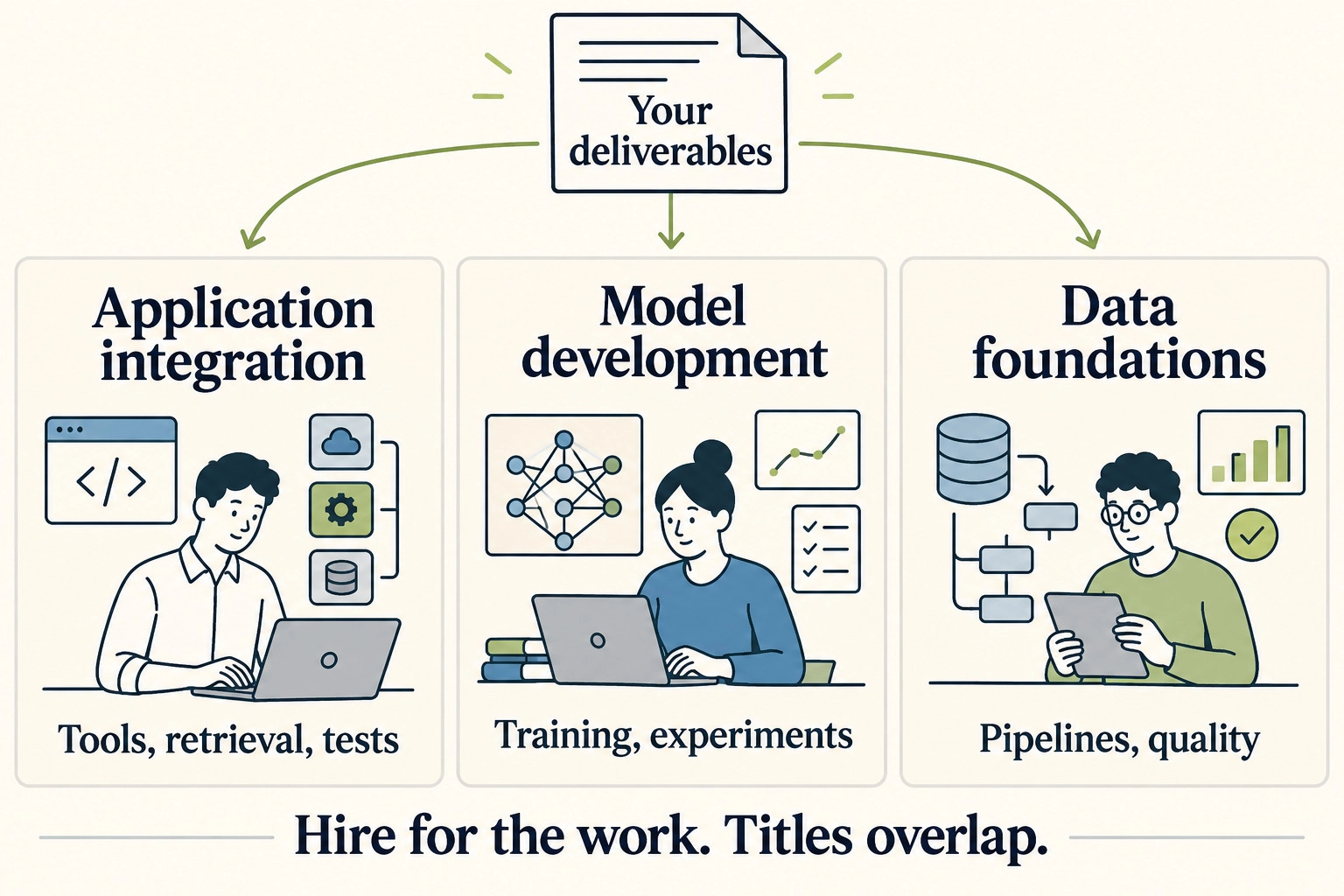
LLM engineer versus ML engineer: compare responsibilities
Job titles overlap. These are working distinctions for this hiring decision, not universal industry standards. A candidate called an AI engineer, backend engineer or ML engineer may have exactly the application experience you need.
| Main responsibility | Evidence to prioritise | Potential gap |
|---|---|---|
| Existing-model LLM application | Integrated product behaviour, retrieval, evaluation and operation | Strong model demos with little production ownership |
| Model training or adaptation | Dataset design, experiments and model validation | API integration without training experience |
| Data platform and ingestion | Reliable pipelines, source quality, lineage and access handling | An assistant built on an unreliable source pipeline |
| AI infrastructure and delivery | Deployments, monitoring, recovery and operating controls | Application code without an operating owner |
You may need one person with overlapping skills. You may need several owners. Decide from the work, its risk and the support available, rather than treating the longest skills list as the strongest hire.
For broader model-development and supplier choices, see our ML engineer hiring and partner guide. This article focuses on turning an existing model into a maintained application.
Ask for evidence at four application boundaries
1. Where information enters the application
Ask the candidate to trace one source document from the original system to the retrieved passage. Who can access it? How does an update reach the application? What happens when access changes or the document is removed?
Retrieval-augmented generation, or RAG, supplies external information to the model at request time. An implementation needs more than an index: source identity, permissions, freshness and useful retrieval results all matter.
OpenAI’s retrieval documentation describes attribute filters that narrow files before semantic search. The API feature does not define your organisation’s access policy. Ask who derives the filter and what prevents a request from bypassing it.
Do not make a particular vector database a hiring requirement unless the role requires it. Exact identifiers, structured records and permissions may involve other search or database techniques.
2. Where model output becomes application behaviour
Ask what the application does with the response. Does it display text, populate a draft or call a business operation? Which fields does ordinary code validate, and which decisions remain with a person?
A well-formed result can still refer to the wrong account or request an unauthorised action. Look for an explanation of validation, authorisation, timeouts and retry behaviour that matches the workflow.
The candidate should explain why the design needs an agent at all. Anthropic’s Building effective agents, originally published in December 2024, recommends starting simply and adding complexity when needed. Use the design principle rather than treating its older tooling examples as a current product catalogue.
3. Where success becomes measurable
Ask for one evaluation that changed a release decision. What was the expected behaviour? Which cases failed? What changed, and what remained untested?
OpenAI’s evaluation guidance recommends task-specific tests, human calibration and continued evaluation as the application changes. For hiring, the useful evidence is the candidate’s implementation and interpretation, rather than a borrowed benchmark score.
Separate retrieval failures from unsupported answers, incorrect tool arguments and application defects. Our agent evaluation guide covers wider test design. A candidate does not need to reproduce an evaluation platform during an interview.
4. Where a running service fails
Ask what an operator sees when a provider times out, a source becomes unavailable or the feature starts giving poor answers. Who investigates, what evidence is available and what can be disabled?
Useful evidence may include a redacted trace, regression case, rollback note or explanation of a production decision. Respect confidentiality. A candidate who cannot share a former employer’s code can still explain responsibilities and trade-offs without exposing it.
Look for ownership at a sensible scope. Someone who built the retrieval component should describe that contribution honestly, rather than claiming responsibility for an entire platform.
Replace the portfolio tour with an evidence request
Use the same core questions for candidates applying to the same role. The US Office of Personnel Management’s structured interview guidance describes predetermined questions and consistent rating standards. Apply that consistency while allowing necessary clarification and accommodations.
This is a proposed discussion aid, not a validated hiring instrument or universal passing rubric.
| Ask for | Evidence it can reveal | Follow-up |
|---|---|---|
| One request traced through a system the candidate worked on | Understanding of identity, data and component boundaries | Which part did you implement or maintain? |
| One failed evaluation and resulting change | Diagnosis and evidence-led iteration | How did you check for regressions? |
| One retrieval or integration trade-off | Judgment about complexity and limits | What simpler option did you consider? |
| One failure or recovery explanation | Operational ownership and honest limits | What could an operator verify independently? |
Record observations as specific evidence, partial evidence or unknown. Absence of a shareable artifact is not automatically absence of skill. Confident explanation without supporting detail should not become confirmed experience either.
A strong discussion often becomes more interesting when the original choice turns out to have been wrong. Listen for how the candidate detected the problem and changed course. Do not reward complexity, framework vocabulary or the number of models named.
Write a role brief that attracts the right experience
Adapt this structure to your product:
- Outcome: the customer task and how the team will check it.
- Ownership: components the engineer will build, maintain and investigate.
- Required evidence: relevant software delivery, integration and evaluation experience.
- Support: available product, domain, data, security and infrastructure owners.
- Constraints: data access, approved providers, operating requirements and deployment environment.
- Outside the initial scope: training a new model or unrelated infrastructure, where applicable.
Name technologies essential to the environment. Keep replaceable tools under useful experience rather than mandatory requirements. A candidate who understands the underlying boundary may learn a library faster than a library expert learns your product’s failure costs.
If you suspect the application needs fine-tuning, establish the reason before making training experience mandatory. Our RAG versus fine-tuning guide separates missing knowledge from a measured behavioural gap. These problems can require different expertise.
Use a bounded assessment, then decide what remains unknown
A portfolio discussion may leave implementation questions open. Choose a small, role-relevant work sample only for those gaps. Use fictional data, a working environment and disclosed criteria.
For this role, a follow-up might ask the candidate to investigate a supplied retrieval defect and explain the relevant access checks. It should not ask them to build your production feature or solve an entire architecture during an unpaid exercise.
Use our developer assessment guide for format, time limits, AI-use policy and reviewer calibration. Keep the evidence requirements specific to this vacancy. Check applicable employment and accessibility requirements with the appropriate adviser.
At the hiring decision, distinguish what the candidate demonstrated from what your team can teach and what needs another owner. One fluent interview or passing task does not prove every part of a production role.
When another hire is the wrong first move
Do not hire a specialist to compensate for an undefined product decision. If you cannot identify the user, approved data and accepted result, scope the workflow first.
A training specialist may be the wrong fit for a straightforward existing-model integration. A broad application engineer may be the wrong fit for research-heavy model development. A solo contractor may be the wrong operating arrangement when several unsupported disciplines need continuing ownership.
If you have the skills and capacity internally, additional staffing may be unnecessary. Where there is a defined gap, Powercode Group’s AI and ML engineering talent service provides a starting point.
Share the customer workflow, existing team and components the engineer must own. That gives a hiring discussion more substance than a list of preferred frameworks.
Frequently asked questions
Does an LLM engineer need to train models?
Not necessarily. An existing-model application may primarily need retrieval, APIs, software engineering and evaluation. Require training experience when adaptation or model development is a demonstrated part of the role.
Is prompt engineering enough for a production application?
Prompt skills can help, but they do not cover the surrounding responsibilities by themselves. Check who owns authentication, data access, integration, testing, failure handling and operation.
Which portfolio evidence matters most?
Prioritise work similar to your application: a traceable request, a meaningful failure, an evaluation that informed a decision and a clear explanation of the candidate’s contribution. A polished interface alone shows little about those boundaries.
Should we require a specific agent framework?
Only when it is essential to the vacancy. Otherwise, assess whether the candidate understands the underlying behaviour and can work within your environment. Framework familiarity does not replace delivery judgment.