RAG vs. Fine-Tuning: Which Approach Should You Use?
The RAG vs fine-tuning decision is not a choice between a basic and an advanced AI system. The two methods solve different problems. Retrieval-augmented generation (RAG) supplies external information at request time. Fine-tuning changes a model’s parameters so it performs a task or follows a behavior more consistently.
Use RAG when answers depend on private, changing, or citable knowledge. Consider fine-tuning when you have a measured problem with format, style, classification, tool use, or another repeatable behavior. Combine them when the application needs both grounded knowledge and specialized behavior.
RAG vs fine-tuning at a glance
| Decision factor | RAG | Fine-tuning |
|---|---|---|
| Primary purpose | Add relevant external knowledge to each request | Adapt model behavior for a defined task |
| Where customization lives | Documents, metadata, retrieval, ranking, and prompt context | Training examples and updated model parameters |
| Changing information | Suitable when the source and index are kept current | Requires new training data and another tuning cycle |
| Source attribution | Can support citations when provenance is retained and rendered | Does not inherently identify the source behind an answer |
| Typical data | Documents, records, metadata, and access rules | High-quality input-output examples or preference data |
| Main failure mode | Retrieves missing, irrelevant, stale, or unauthorized context | Learns weak patterns, overfits, or regresses on other behavior |
| Cost drivers | Ingestion, embeddings, index, retrieval, reranking, and context tokens | Dataset preparation, training, evaluation, hosting, and retuning |
| Best starting point | Knowledge-intensive applications | Narrow tasks with repeatable examples and a proven baseline gap |
AWS recommends starting with RAG for question-answering over custom documents, while its guidance treats fine-tuning as useful for additional tasks and specialized behavior. Google Cloud makes the same core distinction: RAG augments prompts with external knowledge, while fine-tuning changes model parameters. Both sources also note that the approaches can be combined. See the official AWS comparison and Google Cloud fine-tuning guide.
What RAG actually changes
A RAG pipeline searches an approved knowledge source and adds selected content to the model’s context before generation. A typical flow includes ingestion, parsing, chunking, metadata, embeddings or another index, retrieval, optional reranking, prompt assembly, generation, and source rendering.
RAG does not update the model’s parameters. It changes the information available for the current request. That makes it useful for policies, product documentation, customer-specific records, support knowledge, research, and other information that changes or must remain traceable to a source.
RAG works well when
- the application needs current or frequently updated information;
- users need links or citations to source material;
- knowledge is private, tenant-specific, or controlled by access rules;
- content is too large to place in every prompt;
- teams need to add or remove knowledge without retraining a model.
RAG does not solve every accuracy problem
RAG can still return an incorrect answer. The retriever may miss the right document, select an irrelevant passage, use stale content, or pass contradictory evidence to the model. The model may ignore the context or make a claim that the source does not support.
Google’s RAG guidance emphasizes that retrieval quality is critical. If the retrieved material is irrelevant, the response can be grounded yet off-topic or wrong. Build evaluations for retrieval and generation separately instead of treating the final answer as one opaque score.
What fine-tuning actually changes
Fine-tuning continues training a base model on examples selected for a task. Depending on the provider and method, those examples may teach desired responses, preferences, classifications, formats, terminology, or tool-selection patterns.
Fine-tuning is not a reliable substitute for a database. Model parameters do not provide a practical way to update one policy, remove one customer record, enforce document permissions, or cite the source of a factual claim. Use a knowledge system for those requirements.
Fine-tuning works well when
- the model must follow a stable output format across many requests;
- a narrow classification or extraction task needs better consistency;
- the application needs a specific style, tone, or domain vocabulary;
- prompt engineering has reached a measured performance limit;
- a smaller tuned model can meet the target and reduce inference latency or cost.
Fine-tuning requires more than a training run
The difficult work is usually dataset design and evaluation. Examples must represent production inputs, edge cases, refusals, and acceptable variation. Keep separate training, validation, and test sets. Version the dataset, model, system prompt, and evaluation suite so you can identify regressions and roll back.
Model availability also matters. Providers do not support every tuning method for every model. Hosting, regional availability, data handling, and model retirement policies can change the long-term cost of the decision.
Choose RAG when knowledge is the problem
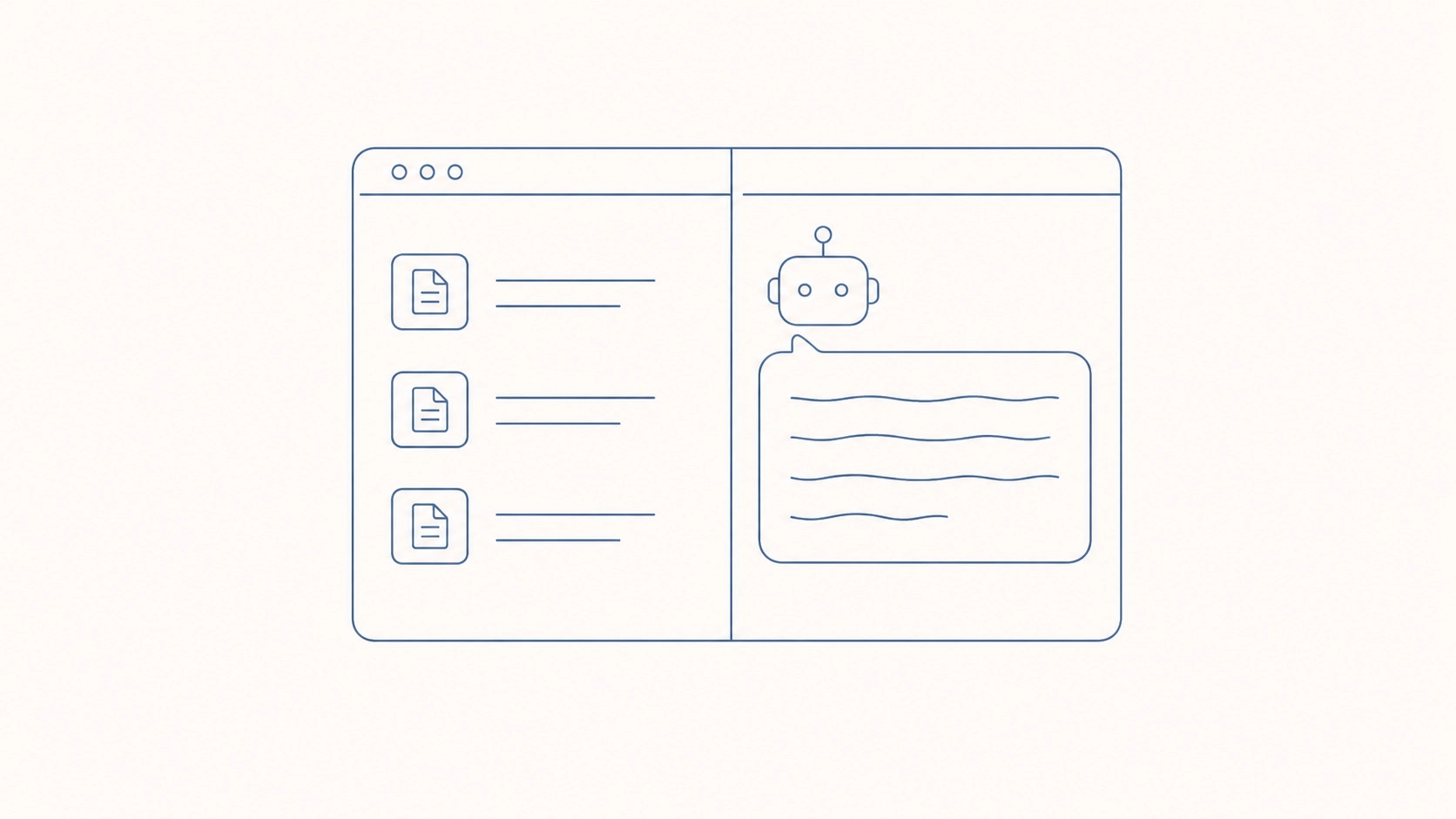
Start with RAG if the application fails because the base model lacks the right information. Common examples include an internal support assistant, product documentation search, contract review, regulated policy lookup, technical troubleshooting, or customer-specific account answers.
The architecture should preserve document identity, version, owner, timestamp, tenant, and permissions. Apply authorization before or during retrieval, not after generation. If one user cannot open a document in the source system, the RAG layer should not place that document in the user’s model context.
Do not assume a vector database is mandatory or sufficient. Keyword search, filters, relational queries, knowledge graphs, and APIs may be better for structured or exact data. Many systems use hybrid retrieval and a reranker. The right pipeline depends on the query, corpus, latency target, and evidence required.
Choose fine-tuning when behavior is the problem
Consider fine-tuning when the model has the necessary information but repeatedly performs the task in the wrong way. Examples include unstable JSON generation, inconsistent classification, domain-specific writing, specialized extraction, or a narrow workflow that prompts alone cannot control reliably.
First prove the gap with an evaluation set. Improve the prompt, examples, tools, and deterministic validation before training. Fine-tuning should solve a measured problem, not serve as a general attempt to make the model “smarter.”
A tuned model can sometimes reduce prompt length or allow a smaller model to handle a repetitive task. That can improve latency and inference economics at sufficient volume. It is why the simple claim that fine-tuning always costs more than RAG is wrong. Total cost depends on training frequency, dataset work, serving model, request volume, context length, retrieval infrastructure, and operational support.
Use RAG and fine-tuning together when both gaps are real
The methods are complementary. A fine-tuned model can provide consistent behavior while RAG supplies current, authorized knowledge. For example, a support system may retrieve the latest product and account information, then use a tuned model to classify the case and produce a response in an approved structure.
Do not start with both by default. Each layer adds failure modes, evaluation work, security controls, latency, and maintenance. Establish a baseline, add the component that addresses the largest measured gap, and introduce the second only when evidence justifies it. This incremental approach also supports the monitoring and feedback loops described in our guide to adaptive AI development.
| Observed problem | First method to test | What to measure |
|---|---|---|
| Answers lack private or current facts | RAG | Retrieval recall, answer support, citation correctness |
| Output format is inconsistent | Prompt, schema validation, then fine-tuning | Valid-output rate and task accuracy |
| Responses use the wrong style or vocabulary | Prompt examples, then fine-tuning | Human preference and style adherence |
| Knowledge and behavior both fail | RAG baseline, then evaluate fine-tuning | End-to-end quality, latency, cost, and regressions |
| Base model already meets the target | Neither | Production quality and operational simplicity |
A decision process that avoids over-engineering
- Define the task and risk. Specify users, inputs, expected outputs, evidence requirements, unacceptable failures, latency, and cost limits.
- Create a representative evaluation set. Include normal cases, edge cases, adversarial inputs, missing information, and permission boundaries.
- Test the simplest baseline. Start with a capable base model, clear instructions, a few examples, and deterministic output validation.
- Diagnose the failure. Separate missing knowledge from weak retrieval, poor reasoning, inconsistent behavior, unsafe action, and application bugs.
- Add one intervention. Introduce RAG for a knowledge gap or fine-tuning for a proven behavioral gap.
- Compare against the same baseline. Measure quality, groundedness, latency, cost, security, and operational effort.
- Run a production pilot. Monitor real queries and update the evaluation set before expanding scope.
AWS recommends the same progression for generative AI proofs of concept: begin with prompt engineering, select RAG when external knowledge is required, and consider fine-tuning for specific style, format, terminology, or narrow tasks. The guidance also recommends starting with the simplest method that can validate business value. See AWS guidance for a generative AI proof of concept.
How to evaluate a RAG system
Measure the retrieval and generation stages separately. A polished answer can hide weak evidence, while a poor final answer can occur despite correct retrieval.
- Retrieval recall: Did the system retrieve the evidence needed to answer?
- Retrieval precision: How much of the selected context was relevant?
- Groundedness: Are material claims supported by the retrieved sources?
- Citation correctness: Does each citation support the nearby claim?
- Permission accuracy: Did retrieval respect tenant and user access?
- Freshness: Did the index contain the expected source version?
- Abstention: Does the system decline when evidence is missing?
- Latency and cost: What do retrieval, reranking, and added context contribute?
How to evaluate a fine-tuned model
Compare the tuned model with the unchanged baseline on a held-out test set. Do not test only on examples that resemble the training data.
- Task accuracy: Does performance improve on the target behavior?
- Format adherence: Does the response satisfy the required schema or structure?
- Regression rate: Which previously correct behaviors became worse?
- Robustness: Does performance hold on edge cases and adversarial inputs?
- Safety: Did refusal, privacy, or policy behavior change?
- Latency and cost: Does the tuned model improve production economics at expected volume?
- Maintenance: How often will data, evaluation, and tuning need to change?
Security and governance considerations
RAG can support document-level permissions and source removal because knowledge remains in an external system. It is not automatically more secure. The index, metadata, retrieved context, logs, and model requests may all contain sensitive data. Enforce authorization, tenant isolation, encryption, retention, and prompt-injection controls across the whole pipeline.
Fine-tuning introduces a different data lifecycle. Review what training data can be uploaded, where it is stored, who can start jobs, how tuned models are shared, and how data can be deleted. Test for memorization and leakage. Provider controls and contractual terms matter for both approaches.
For agents that can act on retrieved information, apply the safeguards in our AI agent security guide. RAG controls knowledge access; it does not authorize tool calls or production changes.
Plan total cost instead of comparing one API price
| Cost area | RAG | Fine-tuning |
|---|---|---|
| Data preparation | Parsing, cleaning, chunking, metadata, permissions | Example design, labeling, review, train-test splits |
| Build | Ingestion, index, retrieval, reranking, citation layer | Training workflow, experiments, model registry |
| Runtime | Search, reranking, context tokens, generation | Model inference and any hosting premium |
| Evaluation | Retrieval, groundedness, permissions, end-to-end answers | Task quality, regressions, robustness, safety |
| Maintenance | Source synchronization, index quality, access rules | New examples, retuning, revalidation, model lifecycle |
The surrounding architecture can cost more than the model call. Our AI agent pricing guide explains how orchestration, tools, retries, monitoring, and engineering affect total cost. The choice of direct API, managed platform, or orchestration layer also changes where you implement RAG and tuning controls; compare those options in our Claude integration architecture guide.
Common mistakes
- Treating RAG as “add a vector database.” Retrieval quality also depends on content, metadata, chunking, filters, query transformation, ranking, and evaluation.
- Using fine-tuning as knowledge storage. Updated parameters do not replace a controlled, current source of truth.
- Assuming RAG eliminates hallucinations. It can improve grounding, but retrieval and generation still fail.
- Assuming fine-tuning is always expensive. A smaller tuned model may be efficient at scale, but dataset and lifecycle costs remain.
- Training on unreviewed production output. This can reinforce errors and unsafe patterns.
- Skipping a baseline. Without a fixed evaluation set, teams cannot prove that added complexity helped.
- Ignoring access control. Retrieved content must follow the user’s permissions before it enters the prompt.
When Powercode Group is and is not the right fit
Powercode Group is a good fit when you need to evaluate an AI use case, build a secure RAG pipeline, prepare and test a tuning dataset, or integrate the selected approach into a production product. Our teams can cover data engineering, backend integration, model evaluation, cloud delivery, and observability. If the missing capability is internal ownership rather than project delivery, use our framework for hiring an ML engineer.
We are not the right fit if you only need access to a generic chatbot or want to fine-tune a model without a defined task and evaluation set. In that case, establish the use case and baseline first. For production support, explore our AI and data science services and machine-learning development.
Frequently asked questions
Is RAG better than fine-tuning?
Neither is universally better. RAG is usually the better starting point for changing, private, or citable knowledge. Fine-tuning is useful for a repeatable behavioral or task-performance gap that prompting cannot solve reliably.
Can RAG and fine-tuning be used together?
Yes. RAG can provide current, authorized knowledge while a fine-tuned model supplies specialized behavior. Add both only when evaluation shows that the application has both types of gap.
Does RAG eliminate hallucinations?
No. RAG can improve grounding, but the retriever may return weak evidence and the model may misread or ignore it. Measure retrieval, groundedness, citation correctness, and abstention.
Can fine-tuning keep a model’s knowledge current?
Fine-tuning can teach patterns from a dataset, but it is difficult to update, remove, authorize, or cite individual facts stored in model parameters. Use an external knowledge source when freshness and traceability matter.
How much data is needed for fine-tuning?
There is no universal number. It depends on the model, tuning method, task complexity, example quality, and required improvement. Start with a clean representative dataset, maintain a separate test set, and expand only when evaluation identifies a coverage gap.