How to Replace a Developer
To replace a developer, secure your company’s access, write down the work that needs an owner and test whether the incoming engineer can build, test and release the application. A folder of documentation helps. A working handover shows whether it is enough.
The difficult part is often knowledge tied to one person: which deployment step fails, why a customer has a special configuration or which unfinished change is safe to release. Start with those dependencies before comparing candidates.
This developer replacement guide focuses on the technical transition. Employment decisions, notice periods and supplier obligations must follow your agreement and applicable local requirements.
Start with the work you cannot afford to lose
List what must keep working during the change: the next customer release, a payment integration or the ability to investigate production errors. Name someone inside the company who can approve priorities and accept the handover. In a five-person engineering team, that may be the CTO.
Separate essential maintenance from work you can pause. Give the new engineer one area to take over first, with a clear boundary and someone available to review their decisions.
If the departing developer struggled because requirements were unclear or nobody reviewed their work, replacing the person leaves that problem intact. Define the responsibility you need. Our software product engineer guide explains how role scope changes the hiring decision.
Check access before the last day
Viewing the code does not mean your company can administer it. Check who controls the repository, cloud accounts, build pipeline, domain records, monitoring and billing. Record the administrator and recovery route for each critical system.
GitHub permissions depend on the account and assigned role. A personal repository has an owner and collaborators; an organisation has different administrative and repository roles. Check the actual setup against GitHub’s access documentation.
Transferring a GitHub repository does not automatically remove the previous owner’s access. A transfer can leave the previous owner and other collaborators with access. Secrets and deploy keys remain associated with the repository too. Review the destination’s actual permissions and credentials using GitHub’s transfer guidance, checked on 12 October 2026.
Create individual accounts for the incoming engineer and grant the access their task requires. Do not copy passwords, private keys or API secrets into handover documents. Record how authorised people retrieve them through your approved process.
Plan the exit sequence with the technical owner. Move services away from personal credentials, verify replacement access, then remove obsolete access at the agreed time. An immediate security risk requires containment; do not keep unsafe access merely to simplify the handover.
Give the replacement a brief they can act on
“We need a senior React developer” describes a skill, not the job ahead. Explain what the person will inherit:
- Owned area: the application or module and its dependencies.
- Immediate task: the first bounded change or investigation.
- Technical context: the stack, runtime versions, test setup and deployment route.
- Known difficulties: fragile tests, undocumented configuration, defects and external dependencies.
- Working arrangement: review owner, working-hour overlap and release approval.
- Handover conditions: outgoing-developer availability and checks needed before departure.
Use a bounded exercise to assess unfamiliar-code and debugging skills, without asking for unpaid production work. Our developer assessment guide covers task design and consistent evaluation.
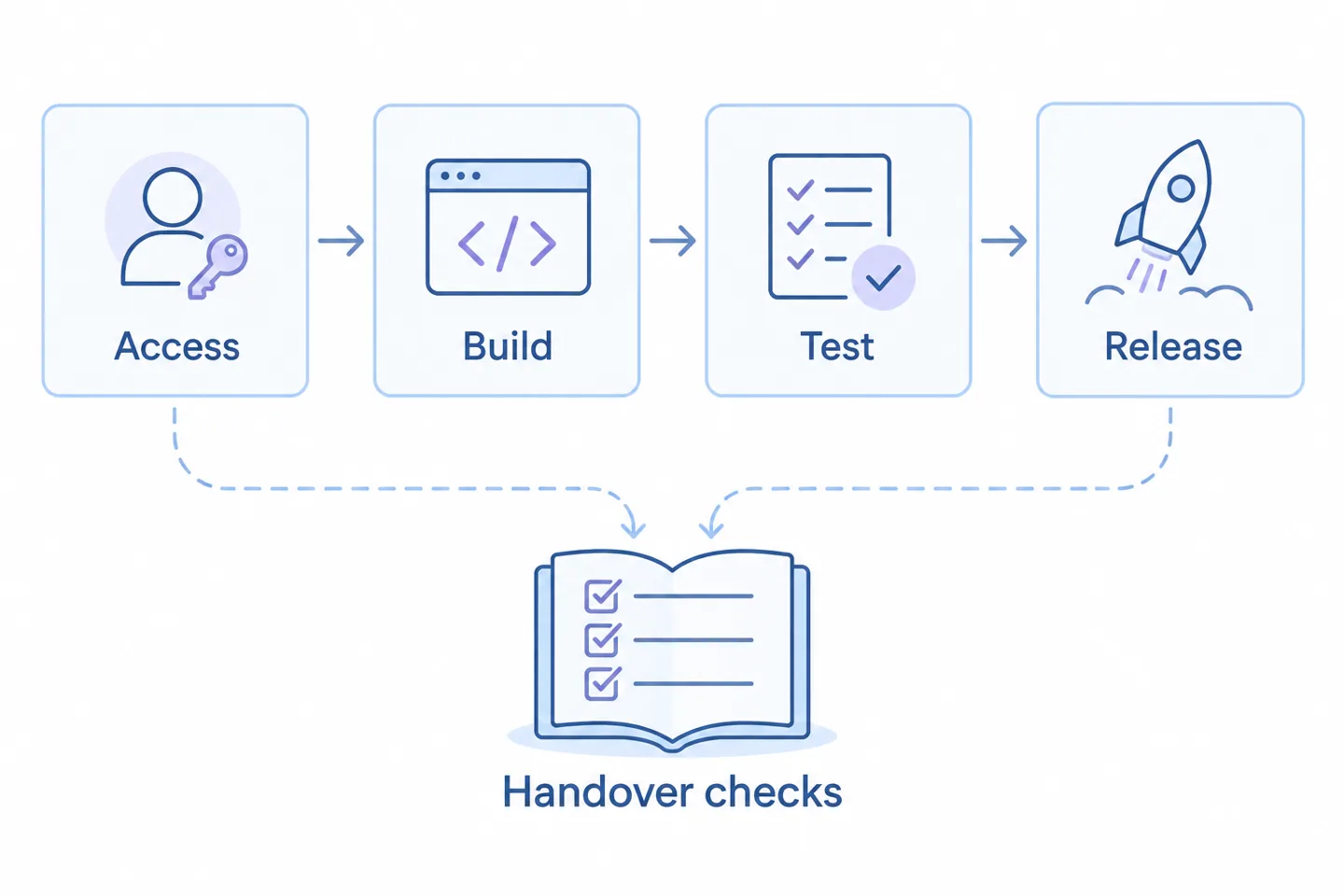
Accept the handover by testing it
Use these readiness checks. Mark each as ready, blocked or deliberately deferred, and name the person responsible for any gap.
Can the new engineer run the application?
They should be able to obtain the correct repository, install documented dependencies and start a safe development environment. Use sanitised test data. Record missing steps and update instructions while each problem is visible.
Can they explain the current state?
Ask them to explain the last accepted release, open branches, unfinished work and known defects in their area. Separate merged changes from deployed ones. Link tickets and decisions instead of relying on a verbal history.
Can they test a small change?
Choose a low-risk task. The engineer should explain the intended behaviour, run relevant checks and show what remains untested. Record a failing baseline test rather than blaming it on the newcomer.
Can the team release and recover?
Have the engineer follow the deployment process in an approved non-production environment. Confirm production approval and result checks. Test recovery safely, in a setting appropriate to the application; avoid an unplanned production exercise.
Does the company hold the useful record?
Keep instructions, decisions and the environment inventory in company-controlled locations. Verify links and permissions from the incoming engineer’s account. A document that only the departing person can open is unfinished work.
“A handover is useful when the next developer can repeat the important steps without relying on the person who is leaving. Check that before you call the transition complete.”
Bohdan Semenov, Head of Delivery at Powercode Group
Budget for overlap, review and missing knowledge
Overlap is paid working time. Include it alongside the incoming engineer’s fee and your review effort.
Here is an illustrative calculation, not a Powercode Group rate or client result. Assume 12 outgoing-developer handover hours at €80 an hour, 12 incoming-engineer hours at €90 and six CTO review hours valued internally at €100. Those items total €2,640: €960 + €1,080 + €600. They exclude later delivery work. The CTO’s internal time value is not necessarily additional cash spending.
Use that time for setup and deployment walkthroughs, unresolved decisions and an accepted small change. More meetings do not necessarily produce a better handover.
Without overlap, start with an inventory and technical discovery. Narrow the first delivery commitment until the engineer understands what they inherited. Our remote developer onboarding guide covers continuing day-to-day integration.
Questions about replacing a developer
How long does a developer replacement take?
There is no reliable universal duration. Candidate availability, access, codebase condition and outgoing-developer support all affect it. Plan around readiness checks; the start date is not the end of the transition.
What if the previous developer is unavailable?
Inventory company-controlled accounts, code, deployments and recent decisions. Ask the incoming engineer to identify gaps before committing to the full backlog. Pause work dependent on knowledge or access you have not recovered.
Should the replacement get production access immediately?
Only when their task requires it and the company has approved the permission. Start with setup and safe-testing access. Agree review, logging and release responsibility before widening it.
Can a staffing provider handle the whole transition?
A provider can supply an engineer and agreed support. Your company still needs to provide access, priorities and someone who can accept the work. Put additional handover or delivery responsibility into the agreement.
Find a replacement for the work you have
If you can direct and review the work but need another engineer, discuss the role and transition requirements with Powercode Group’s staff augmentation team. Bring the replacement brief, access gaps and handover checks. Those details are more useful than a technology list alone.