AI Workflow vs AI Agent: How to Choose the Right Architecture
An AI workflow follows a path that people define. An AI agent can choose its next action within set limits. Use a workflow when the steps, approvals and exceptions are known. Use an agent when the task is open-ended enough that planning and tool selection create real value. Many production systems need a bounded hybrid rather than either extreme.
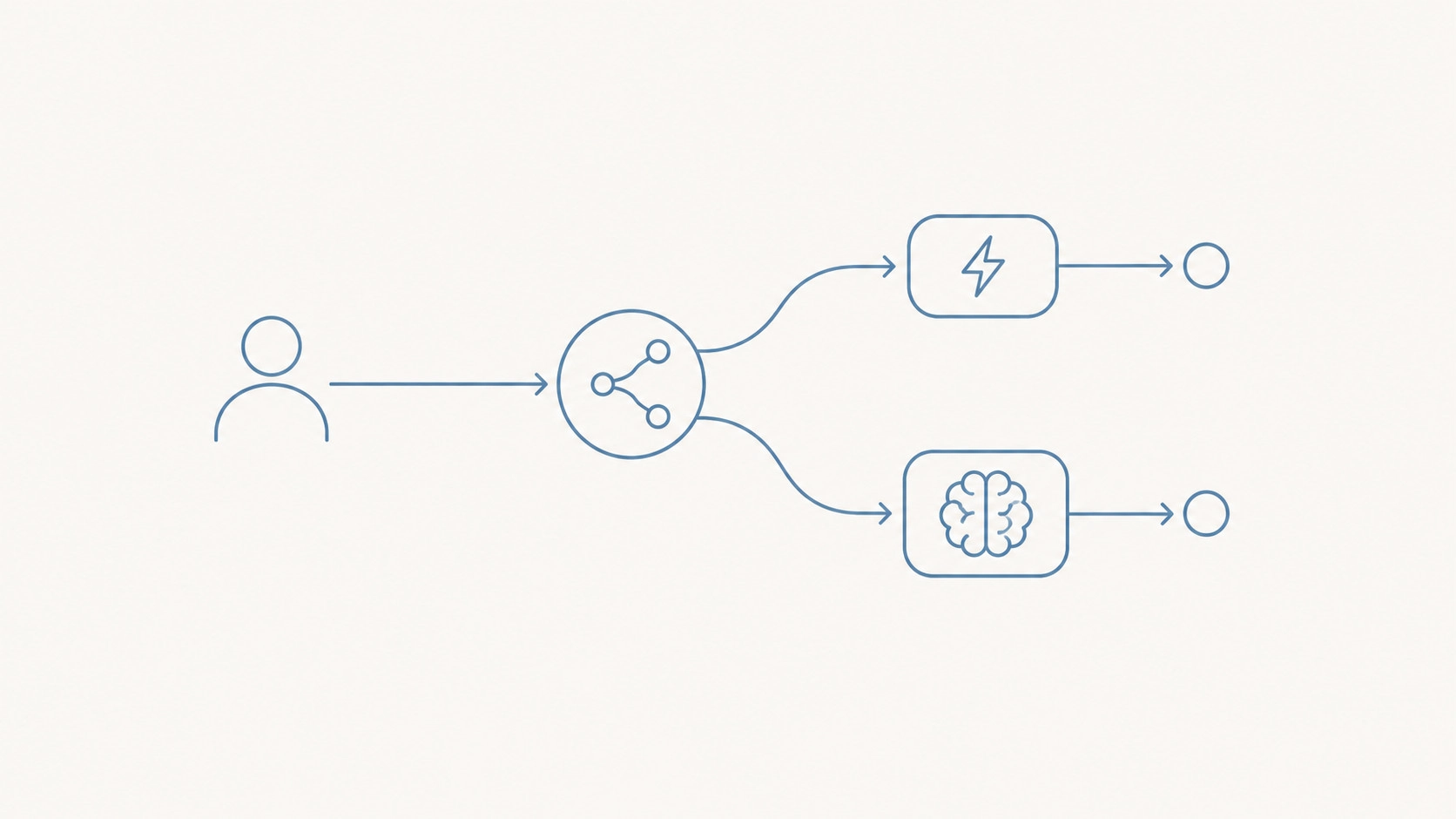
AI workflow vs AI agent: the practical difference
The clearest question is: who decides what happens next?
- In deterministic automation, developers define both the steps and the rules.
- In an AI workflow, developers still define the path, but a model performs bounded tasks such as classification, extraction or drafting.
- In an AI agent, the model can plan, choose tools and adjust its next step after observing a result.
This distinction follows the architecture described in Anthropic’s guide to effective agents: workflows use predefined code paths, while agents direct their own process and tool use. Google Cloud similarly describes agents as a fit for open-ended problems that require autonomous decisions and multi-step work in its agentic architecture guidance.
| Design | Who controls the sequence? | Best fit | Main trade-off |
|---|---|---|---|
| Deterministic automation | Code and rules | Stable, repetitive processes | Breaks when inputs or exceptions change |
| AI workflow | Code controls the path; models handle bounded steps | Known process with unstructured text, images or classification | Less flexible outside the designed path |
| AI agent | The model chooses actions within policy and tool limits | Open-ended tasks that need planning, iteration or recovery | Higher evaluation, security and operating burden |
| Bounded hybrid | Code fixes high-risk stages; an agent handles selected decisions | Variable work with clear control points | More interfaces and handoffs to test |
Start with the task, not the label
“Agentic” can sound more advanced than “workflow,” but autonomy is not a maturity score. It is a design cost. A system that may choose among tools, retry actions and change plans needs stronger evaluation, permissions, monitoring and stop conditions than a fixed sequence.
Before selecting an architecture, write down the task in operational terms:
- Input: What starts the process, and how variable is it?
- Outcome: What observable result means the task is complete?
- Decision rights: Which choices may the system make without approval?
- Tools and data: What may it read, create or change?
- Exceptions: Which cases must stop, retry or move to a person?
- Evidence: What logs, evaluations and business measures will show whether it works?
If the sequence can be written clearly and exceptions are limited, a workflow is usually the better starting point. If the route depends on new information discovered during execution, a bounded agent may earn its added complexity.
Five variables that should decide the architecture
1. Task variability
Stable inputs favor rules and workflows. An agent becomes more useful when it must interpret an unfamiliar situation, gather missing context and revise a plan. Do not confuse messy source data with an open-ended task. A workflow can still process unstructured documents if the required output and path are known.
2. Consequence of a wrong action
The more costly or irreversible the action, the less freedom the system should have. Drafting a response is different from sending it. Recommending an account change is different from executing it. Keep high-impact steps behind explicit policy checks, approvals or deterministic services.
3. Need for recovery
An agent can observe that a tool failed, choose an alternative and continue. That is useful when recovery paths cannot all be declared in advance. It is unnecessary when a normal retry, queue or error branch already solves the problem.
4. Evaluation difficulty
A workflow is easier to test step by step. An agent creates a larger space of possible paths, so teams need scenario-based tests, tool-call checks and clear completion criteria. Our guide to agent evaluations explains how to turn those requirements into release evidence.
5. Operating ownership
Someone must own prompts, tool contracts, data access, model changes, logs and incidents after launch. If that operating model is missing, extra autonomy increases exposure faster than value. Review the access and control questions in our AI agent security guide before expanding tool permissions.
A worked example: handling supplier invoices
Consider a process that receives supplier invoices, validates fields and prepares them for approval.
A deterministic automation can ingest a standard invoice, compare required fields and move a valid record to the next system. It works when formats and rules are stable.
An AI workflow can add a model at a bounded step: extract fields from varied documents, classify the expense and flag low-confidence values. Code still controls validation, approval and posting. This is often enough.
A bounded agent may help when resolving an exception requires several context-dependent actions. It could inspect the purchase order, check a contract, ask an authorized person for missing information and prepare a resolution. The agent should not gain payment authority merely because it can investigate the case.
This example also shows why an architecture can evolve. Start with the predictable path. Record the exceptions. Add agentic behavior only where those exceptions are frequent, valuable and safe enough to justify it.
Use a hybrid when control and flexibility belong in different places
A hybrid design keeps the overall business process explicit while giving an agent freedom inside one bounded stage. A typical pattern is:
- Validate the request and identity with deterministic code.
- Classify risk and task type.
- Send routine work through a fixed workflow.
- Allow an agent to investigate a defined class of complex cases.
- Require approval before high-impact actions.
- Record the route, tools, evidence and final outcome.
Routing is one component of this design, not the article’s main job. It can separate simple and complex work or select an appropriate model. It also adds another decision point that must be measured. Use the cost controls in our cloud cost optimization guide, but do not optimize model spend at the expense of task quality.
Controls to design before release
The safest time to define controls is before the agent can touch production systems.
- Permission boundaries: expose only the tools and data required for the task.
- Structured tool contracts: validate inputs and outputs instead of letting free-form text trigger actions.
- Budgets: limit steps, retries, elapsed time and model spend.
- Approval gates: require people to confirm irreversible or sensitive actions.
- Fallbacks: define what happens when confidence is low, a tool fails or the run reaches its limit.
- Traceability: retain enough evidence to reconstruct the route without logging secrets unnecessarily.
- Release tests: test normal cases, edge cases, adversarial inputs and recovery paths.
The integration layer matters as much as the model. Our comparison of API, platform and framework responsibilities shows where control can move between your team and a provider.
When an AI agent is the wrong choice
Do not start with an agent when rules already cover the task, when a wrong action would be difficult to reverse, or when no team can maintain the system after launch. A standard product may also be better when the process is common and differentiation is low.
An agent is also a poor substitute for unresolved ownership. If teams disagree about the process, source of truth or approval rights, autonomy will automate the disagreement rather than fix it.
Architecture decision checklist
- Can we describe the outcome without prescribing every step?
- Which decisions genuinely require context-dependent reasoning?
- Which actions must remain deterministic or human-approved?
- Can we test success with representative scenarios?
- Can we observe routes, failures, cost and business outcomes?
- Is the expected value greater than the new operating burden?
- Who owns the system after the first release?
If most choices and exceptions are already known, build the workflow first. If meaningful work remains open-ended, add a bounded agent where it can earn its freedom.
Build the smallest architecture that can prove the outcome
Powercode’s AI & Data Science and custom software development teams can help map the task, prototype the narrowest viable design and define release evidence. The goal is not to maximize autonomy. It is to deliver a system your team can trust, operate and improve.
Frequently asked questions
Is an AI workflow the same as an AI agent?
No. An AI workflow uses a path defined by code, even when a model performs one or more steps. An AI agent can choose its next action within the tools, policies and limits supplied by the system. Product labels are inconsistent, so inspect the control flow instead of relying on the name.
Can a workflow include an AI agent?
Yes. A fixed workflow can call an agent for one open-ended stage, then return to deterministic validation, approval and recording. This bounded hybrid often provides useful flexibility without handing the complete business process to the model.
When should a team move from a workflow to an agent?
Move only when real exception data shows that fixed paths cannot handle valuable cases efficiently, and when the team can test and operate the additional autonomy. Keep the existing workflow as a baseline. Compare completion quality, operating effort, latency, cost and failure severity before expanding the agent’s role.