Back

Claude Integration Architecture: Direct API, Managed Platform or Orchestrator?

Most engineering leads treat the Claude API as a plug-and-play commodity, which is exactly why their projects stall when scaling hits a production wall. Integrating Anthropic’s models is not about piping JSON into a request. It is a decision about how much of your product’s intelligence you want to own versus rent.

There are three architectures worth considering, and the right one depends far more on your team than on your use case. This guide compares them on control, latency, compliance, lock-in and cost, and states plainly where each is the wrong call.

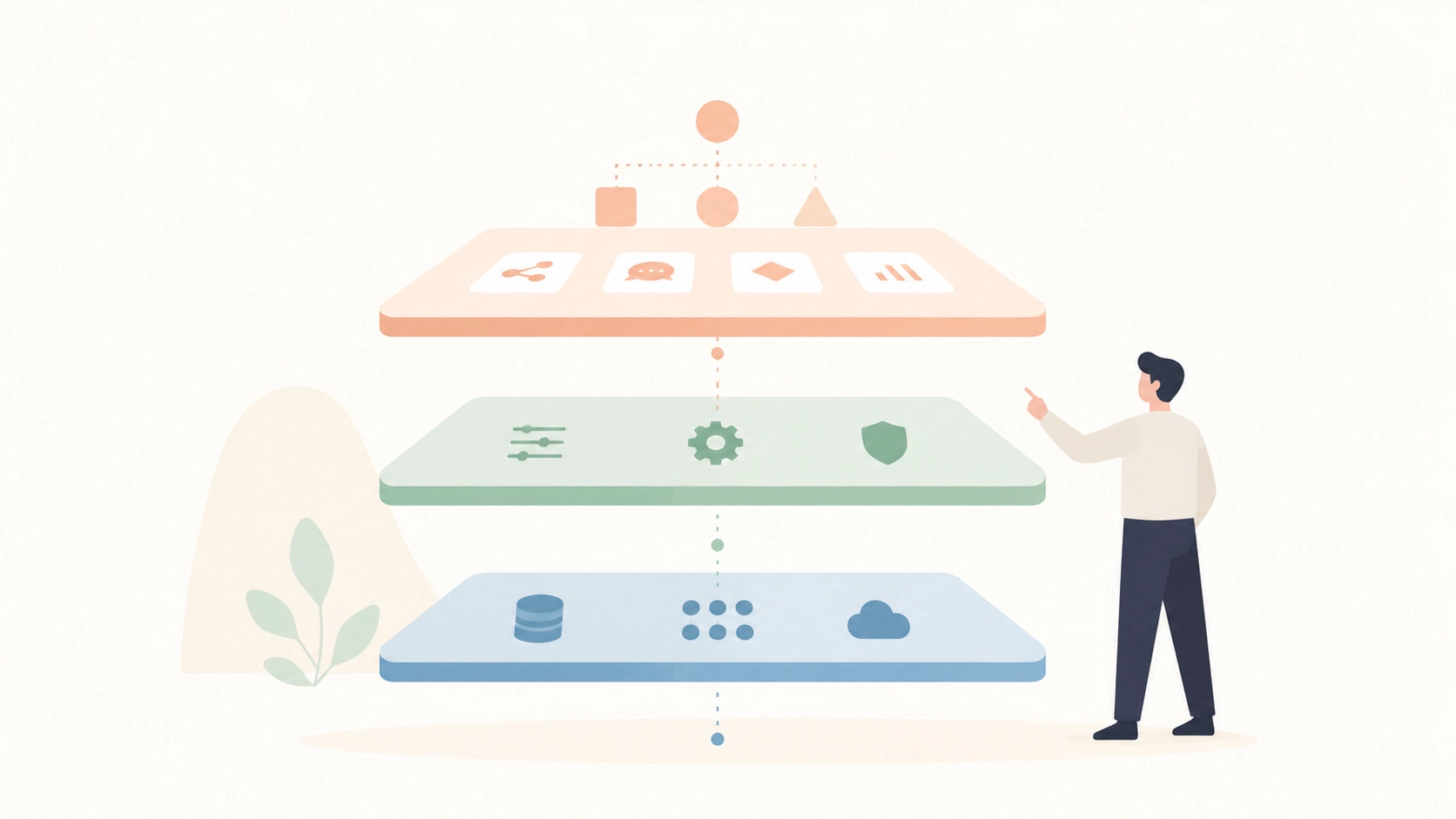
Diagram comparing three ways to integrate a language model: direct API, managed platform and orchestration framework

The three architectures at a glance

Criteria Direct API integration Managed enterprise platform Framework orchestrator
Control Absolute Limited Moderate
Latency Lowest — native Higher — abstraction overhead Variable
Compliance Yours to build Managed, abstracted Variable
Vendor lock-in Low, but code-heavy High, platform-heavy Medium
Cost model Per-token, granular Bundled premium Tokens plus orchestration tax
Time to first release Slowest Fastest Fast for prototypes
Debuggability at 2am High Low Lowest

That last row is not a joke. It is the criterion most teams skip and most regret skipping.

Direct API integration

You hit the Anthropic API endpoints from your own backend services, and you own everything: rate limiting, retries, token budgeting, conversation storage, prompt versioning.

What you gain. The full request lifecycle is yours, so profiling latency is straightforward. No third party sits between your data and the model. You can add fallback models or swap providers without re-architecting a middleware layer you did not write.

What it costs. Context-window optimisation, prompt versioning and PII scrubbing all become your engineering problem. None of them are hard individually; together they are a quarter of work that produces no visible feature.

Choose this when AI is a core differentiator in your product rather than a feature you are adding, and you have a backend team comfortable with asynchronous state. It is the only path that avoids the lowest-common-denominator performance ceiling of managed platforms.

Managed enterprise platform

A pre-packaged abstraction over the model API. Authentication, logging and audit trails come out of the box, usually with a management console on top.

What you gain. Speed. An internal tool can be live in days rather than weeks, and the built-in compliance features often clear procurement before anyone writes code — which, in a regulated organisation, is the actual bottleneck.

What it costs. Visibility into raw request-response latency, and independence. You inherit the provider’s uptime and their particular implementation of the underlying models.

Choose this when you are building internal tools and shipping matters more than milliseconds. An HR or IT support assistant does not need a hand-built stack, and building one is a poor use of your senior engineers.

A dashboard showing token usage and latency metrics for a production AI integration

Framework orchestrator

Frameworks such as LangChain sit between your application and the model, managing chains of reasoning, retrieval and state.

What you gain. A standard way for your team to talk to models across services, built-in retrieval-augmented generation and document ingestion, and a much faster path to multi-step agents that make sub-calls to the model.

What it costs. Debuggability. When a chain breaks, you are tracing through layers of abstraction someone else designed. There is also a real performance tax from the orchestration layer itself.

Choose this when your product needs genuinely complex multi-turn interactions — fetching from your databases, vectorising, reasoning across steps. Expect to strip the framework out of your highest-traffic endpoints eventually and rewrite that path thin. That is a normal lifecycle, not a failure.

Two things we learned running this ourselves

We build these systems for clients, and we run them internally, which has produced two lessons worth more than the architecture comparison above.

Decide what the system says when it does not know. Our internal knowledge base is maintained by an agent that ingests raw sources and writes structured, linked pages. The first version was dangerous: asked for a source URL or a date it did not have, it produced a plausible one. Confident, well-formatted, wrong. The fix was a single rule written into its instructions — unknown is always better than a guess — and every fact now carries a source or is explicitly marked as missing. Output looks worse and is usable, because you can act on a document that shows its holes and you cannot act on one that hides them. Whatever architecture you pick, that rule belongs in the system prompt before you ship.

The evaluation problem has moved. We onboarded a Rails developer onto a client project where, for the first month, he was required to work exclusively through a project-specific model the client had built. Not encouraged — required. His evaluation was based on what he could get out of it: how he prompted, how he reviewed what came back, how reliably he caught what it got wrong. The skill being assessed was not the framework. It was judgment applied to machine output. If you are staffing an AI integration, that is what you are actually hiring for, and most interview processes do not test it at all.

Privacy and compliance in 2026

Privacy stopped being a security-review checkbox and became a functional requirement. Two questions decide your architecture as much as any latency budget: where does the data live, and can it reach anyone’s training set.

Direct API users have the simpler position — you manage encryption at rest and in transit yourself, and the data path is one you can draw on a whiteboard. On a managed platform you are outsourcing data governance, which is fine as long as it is a decision rather than an assumption. Verify in the contract, not the marketing page, that your inputs cannot be used to train base models, and confirm where the data physically sits. For EU companies that second question is frequently the one that eliminates an otherwise ideal vendor.

An engineer reviewing data-residency and compliance requirements for an AI system

How to choose

Stop looking for the best architecture and look for the one that creates the least friction for your specific team.

  • Assess backend maturity honestly. A team fluent in asynchronous event loops and distributed state should not pay a platform tax. A team that is not, should. This is a different question from how your engineers use AI in their own daily work — we covered that separately in a senior lead’s guide to Claude Code.
  • Define your latency tolerance in numbers. If a customer-facing interface has a 300ms budget, abstraction overhead will decide this for you.
  • Choose what you can debug at 2am. A custom integration is an asset until the person who built it leaves, at which point it is a liability. Pick the architecture your team can still reason about after turnover.
  • Separate the prototype decision from the production decision. Starting on a framework and migrating the hot path later is a legitimate strategy. Pretending you will never need to migrate is not.

Where we are the wrong choice

If you already have a strong platform team and a clear architecture, you do not need an outside partner for this — you need capacity, and hiring it directly will be cheaper than contracting a firm.

Where we fit: you have decided AI belongs in your product, you do not yet have the engineers who have built one in production, and you would rather borrow that experience than spend two quarters acquiring it. We do that through AI and data engineering, machine learning delivery and placing vetted AI and ML engineers inside existing teams. If you are weighing that against building in-house, our comparison of the three models for hiring dedicated developers covers the trade-offs.

Frequently asked questions

Is direct API integration harder to scale than a managed platform?

Not inherently. Scaling a direct integration is mostly rate-limit handling, caching and retry logic — well-understood problems with well-understood solutions. Managed platforms handle these for you, but they also mask underlying capacity issues, so you find out about a ceiling later and with less information.

Should I use more than one model provider?

Design the application to be model-agnostic regardless of whether you use one today. A provider-neutral interface costs little upfront and lets you route different tasks to different models, or switch entirely, without a refactor. The cost of retrofitting that abstraction after launch is what makes teams stay on a provider they have outgrown.

Are framework orchestrators worth the performance cost?

For prototyping and internal tools, usually yes. For high-traffic production endpoints, plan to strip the framework out of the critical path and write that interaction thin. Treat the framework as scaffolding rather than foundation.

How should I manage the context window?

Implement your own sliding-window or summarisation logic based on how your application is actually used, rather than relying on a framework’s general-purpose defaults. Context strategy is one of the few places where domain knowledge beats a generic implementation by a wide margin.

How long does a first production integration take?

A managed-platform internal tool can ship in one to three weeks. A direct integration for a customer-facing product with proper guardrails, evaluation and monitoring is realistically two to four months. Anyone quoting a customer-facing production AI feature in three weeks is describing a demo.

What should I ask a vendor before signing?

How they handle a model that degrades after deployment. How they keep your proprietary data out of anyone’s training set. Whether they can describe a case where they recommended not using a model for a problem. And what happens to the infrastructure and code if you part ways in six months. We expanded on this in our guide to evaluating ML partners.

Does the architecture choice affect what engineers I need to hire?

Substantially. Direct integration needs backend engineers comfortable with distributed state and observability. A managed platform needs a product-minded engineer and far less specialist depth. An orchestrator sits between the two and demands someone who will read the framework’s source when it misbehaves, which is a specific temperament as much as a skill.

How do we evaluate whether the integration is actually working?

Decide the evaluation method before you write the integration, not after. That means a fixed set of representative inputs, an expected-output standard, and a way to re-run them on every change. Teams that skip this ship something that feels right in a demo and cannot tell you six weeks later whether a prompt change made it better or worse.


Powercode Group builds AI systems and sources the engineers who run them, working from Warsaw, Berlin and London. If you are choosing an architecture for an Anthropic-powered project and want a second opinion before you commit, tell us what you are building.


HAVE A PROJECT FOR US?

Let’s build your next product! Share your idea or request a free consultation from us.

Contact Us >