How Much Does a Developer Hiring Delay Cost?
A developer hiring delay can cost you cover time, extra recruitment work and delayed delivery. Subtract employment spending you avoid while the role stays empty. The cost of a developer vacancy depends on the work actually blocked; an open position alone does not make interim staffing worth buying.
A founder or CTO may first notice the cost in their calendar: customer calls moved, technical decisions postponed and evenings spent covering tickets. Put those hours beside the delayed milestone before approving another hiring expense.
Compare the next period of waiting with the alternatives available now. A temporary engineer, a smaller release or another month of patient hiring can each be the right choice.
What belongs in the cost of a developer vacancy?
Recruitment platform JOIN distinguishes the cost of vacancy from the cost of filling a role. Its glossary includes lost output, cover costs and missed revenue. For engineering, estimate specific work and consequences instead of dividing company revenue by headcount.
A developer supporting a customer launch has a different impact from one whose roadmap is undecided. Start with four items.
1. Work other people cover
Record the hours your CTO, engineers or contractors spend covering the vacancy, including additional paid cover. For salaried colleagues, distinguish time value from cash spending: their salary may not change, but their planned work does.
Give those hours an internal value only when it helps the decision, and state how you chose it.
2. The consequence of the delay
Name the affected milestone and a consequence you can support: an agreed customer credit, an extended contractor engagement or a postponed release with a defensible contribution estimate.
Revenue deferred is different from revenue lost. A later payment affects timing; it is not automatically a permanent loss. Use a range for uncertainty or describe the impact without inventing a precise figure.
3. Extra search costs
Count interview time, advertising or recruiter work caused by the longer search. Exclude costs that are the same under every option. The permanent hire’s eventual placement fee may still be payable whether you wait or use an interim engineer.
4. Employment spending avoided
Subtract salary and employer costs that would have been paid during the vacancy, using the same period. Waiting has costs, but an empty role also reduces spending.
For salary, rates and engagement budgets, use our developer hiring cost guide. Here, the question is whether covering a known gap changes the outcome enough to justify its cost.
A six-week example: waiting is cheaper
Imagine a 20-person software company covering the next six weeks while hiring a permanent developer. These figures are illustrative assumptions, not market averages or Powercode Group prices.
Assume the same permanent hire arrives after that period under either option. The planned employment cost for the vacant role is €9,000 over the six weeks. We compare each option with the budgeted cost of having that role filled, including any exit handover at the end of the six-week period.
Option A: keep waiting
- CTO cover: 12 hours a week × six weeks × €100 internal hourly value = €7,200.
- A customer credit if the milestone is late: €6,000.
- Employment spending avoided: €9,000.
The incremental economic cost is €7,200 + €6,000 − €9,000 = €4,200. The CTO time may not create another €7,200 cash payment.
Option B: bring in an interim engineer
- Supplier fee for the six-week period: €18,000.
- CTO ramp-up and review: 24 hours × €100 = €2,400.
- End-of-engagement handover: eight CTO hours × €100 = €800.
- Employment spending avoided: €9,000.
Assume the supplier fee includes the engineer’s own handover time and that the engineer starts soon enough to avoid the customer credit. The incremental economic cost is €18,000 + €2,400 + €800 − €9,000 = €12,200.
Waiting is €8,000 cheaper on these inputs. The calculation does not support buying interim capacity just because hiring feels slow.
Change the assumed late-delivery consequence to €20,000 and waiting costs €18,200. Interim cover would then be €6,000 lower, but only if it can prevent that consequence. Check availability, access, task fit and review capacity before treating the saving as achievable.
Check for costs counted twice
Do not add the value of missing developer output and the revenue consequence of the same delayed feature as separate losses. Choose the consequence that best describes the impact. Do not count a salaried CTO’s time as extra payroll and an opportunity cost unless those costs genuinely differ.
Common costs cancel out in the comparison. Others differ: interim onboarding, overlapping supplier fees or an extra handover. Use the same dates and scope.
Keep cash and internal time on separate lines. A company may prefer the cheaper economic option but still lack cash for the supplier invoice.
“Before paying to fill a gap faster, name the work that is waiting and what the delay costs. If nobody can answer that, improve the brief before increasing the hiring budget.”
Maciej Nasalski, Powercode Group
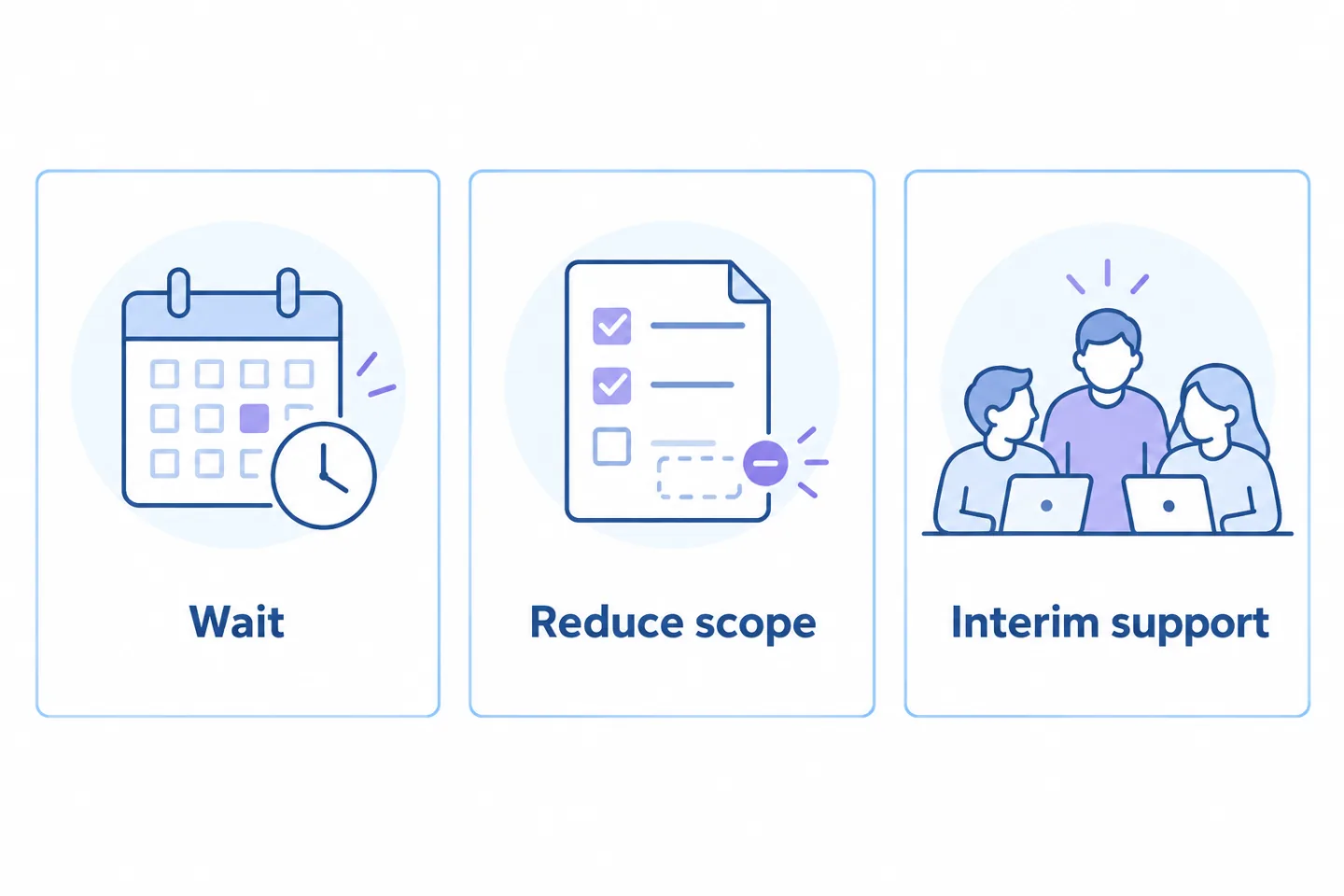
Compare three choices before buying cover
Wait when the consequence is manageable and your team can cover essential work without creating a larger problem. Set a review date so waiting does not become an unexamined default.
Reduce scope when a smaller release can protect the commitment. Agree the change with the customer or product owner. Check what it saves and postpones; moving a feature later can affect another team.
Use interim capacity when the work is clear, the gap is bounded and someone can direct and review the engineer. Compare the actual proposal with what they can take over, including ramp-up and exit terms.
If you need someone to clarify the product, set priorities and coordinate delivery, another developer may not fill that responsibility. Our delivery-model comparison separates extra capacity from supplier-led delivery.
Make the permanent search easier to finish
Interim cover should not hide an unfillable job description. Separate capabilities needed on entry from knowledge someone can learn. Decide what requires specialist depth and what needs broader product judgement. Our product engineer guide can help narrow the role.
Give one person authority to decide, agree interview stages and evaluate the work consistently. Use the assessment guide for a bounded exercise rather than adding another interview without a purpose.
Questions about developer hiring delays
Is an interim developer always cheaper than waiting?
No. Fees, onboarding and handover can exceed the consequence of waiting. Compare costs over the same period and check whether the engineer can resolve the work causing the delay.
Can we calculate vacancy cost without a revenue forecast?
Yes. Start with paid cover, diverted hours, contractual consequences and employment spending avoided. Keep uncertain revenue outside the total or show it as a separate scenario.
Should we lower the hiring bar to finish sooner?
Revisit unnecessary requirements, not capabilities needed to do the job safely. An earlier start helps only if the person can handle the responsibility. A narrower role may be easier to fill than a weaker assessment standard.
What should we send a staffing provider?
Send the blocked work, required skills, expected duration, working hours and review support. Define the first useful contribution. Ask about realistic availability, ramp-up, fees and handover before comparing proposals.
Choose support for the gap you can define
For a temporary gap, discuss the role and scope with Powercode Group’s staff augmentation team. For the permanent search, use IT recruitment and talent acquisition. Bring the vacancy calculation and the work needing an owner so the conversation can test whether additional capacity is the right purchase.