Do You Need a Full-Time DevOps Engineer?
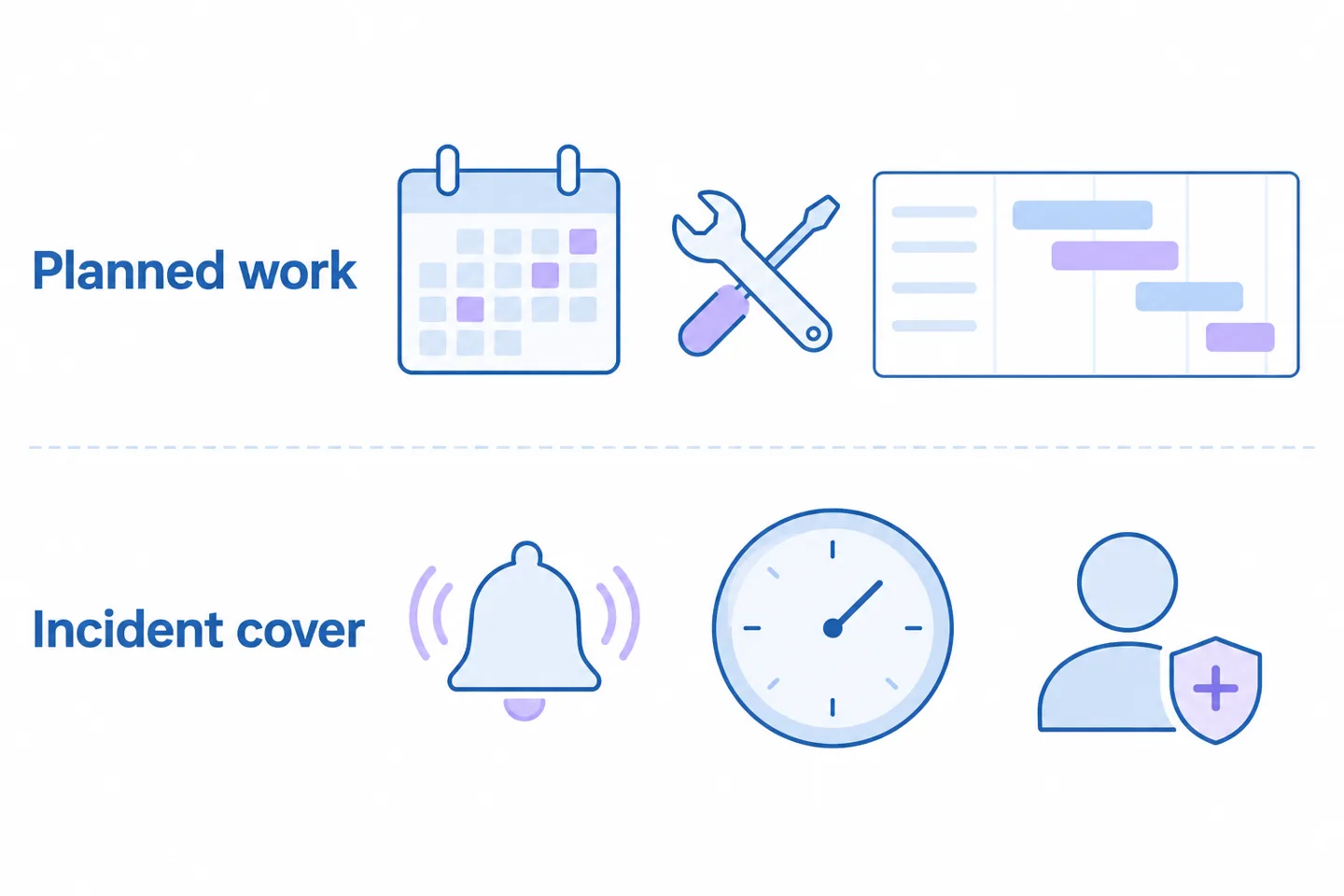
A full-time DevOps engineer makes sense when you have substantial, continuing infrastructure work that needs attention throughout the working week. If the need is mostly planned improvements, a part-time engineer may fit better. If the problem is round-the-clock support, compare coverage separately: one full-time hire does not create a 24/7 service.
A small team can pay for more hours than it needs and still leave production support unclear. Start with the work, the required availability and the person who will direct it. Then choose the hiring model.
What work keeps coming back?
List the infrastructure work completed in the last month, the work postponed and the interruptions handled by developers or the CTO. Include tasks that disappear into chat messages rather than reaching the backlog.
Separate the list into three groups:
- Planned engineering: improving deployment pipelines, updating infrastructure configuration, setting up monitoring or fixing recurring cloud-cost problems.
- Routine upkeep: reviewing alerts, maintaining environments, checking access and keeping documentation useful.
- Incident response: investigating a failed deployment or production problem when it happens, including outside normal working hours.
A deployment improvement can usually be scheduled. A production failure cannot always wait for the engineer’s next booked session.
Google Cloud’s DORA software-delivery research connects dependable releases with automated deployment, testing, monitoring and version control. Its continuous-delivery guidance describes useful work to improve. It does not prescribe a staffing ratio or a separate DevOps department.
Our DevOps hiring guide covers role definition and assessment. The question here is narrower: how much capacity do you need, and when must it be available?
A small workload can still contain serious risk
Imagine a SaaS team with six developers and one CTO. Its application runs on Amazon Web Services. GitHub Actions handles deployment, and infrastructure changes are recorded in Terraform. Most weeks are quiet, but the CTO is the only person who understands the release setup.
The following monthly workload is illustrative, not a market benchmark:
- Eight hours to improve the deployment pipeline.
- Six hours for infrastructure changes and review.
- Four hours for monitoring and alert maintenance.
- Four hours for cloud-cost investigation.
- Two hours for documentation and a walkthrough with another engineer.
That adds up to 24 planned hours. It suggests a bounded part-time engagement could be worth exploring. It does not include onboarding or predict incident work.
Now ask who responds if deployment fails on Friday evening. The monthly total does not answer it. Neither does the job title.
Record the response window, escalation contact and backup separately. If the business needs support outside booked hours, specify that requirement rather than assuming it comes with “fractional DevOps”.
When part-time DevOps support makes sense
A fractional DevOps engineer provides part-time engineering capacity under an agreed arrangement. The label alone says little about hours, response times, backup or responsibility.
Consider part-time support when you have a clear improvement backlog, the work can be scheduled and a technical lead can set priorities. It can also help when developers are repeatedly pulled away from product work to solve infrastructure problems.
Give the engineer an area to own. For example: make deployments reproducible, document rollback and remove the most common release failure. Specify how the team will check completion.
This arrangement becomes harder when requests regularly arrive without notice, several teams need immediate infrastructure decisions or nobody inside the company can direct the work.
Cloud spend can be part of the backlog, but do not buy an engineering role from the size of the bill alone. Our cloud-cost optimisation guide covers what needs changing and how to check the effect.
When a full-time hire is the stronger choice
Full-time capacity becomes more useful when the need lasts beyond one project and the engineer must work closely with the product team each day.
Look for a continuing combination of responsibilities:
- Frequent infrastructure changes that need review and implementation.
- Several environments or services with ongoing maintenance needs.
- Recurring interruptions that displace important engineering work.
- A substantial reliability or migration roadmap.
- Regular coordination with developers on production problems.
Use the backlog and interruptions together. A long wish list is not enough if the business will never prioritise it. A short ticket list can also hide a heavy support burden handled elsewhere.
Before hiring, identify a backup. One employee can take leave, be unavailable or move on. A full-time contract buys capacity; continuity still needs a plan.
“Before choosing full-time or part-time DevOps support, separate the improvement backlog from the support obligation. The same engineer may help with both, but the hours, response expectations and backup need to be agreed.”
Bohdan Semenov, Head of Delivery at Powercode Group
When to compare a managed service instead
A managed service may suit a team that needs an agreed support function rather than another engineer to direct. Its value depends on the service scope.
Ask what the provider monitors, what it can change, when it responds and which problems remain with your developers. An infrastructure provider may investigate a failing server while your team still owns an application bug. Agree how those cases move between people.
Read the exclusions too. A response commitment is different from a promise to restore the application within that time.
For the broader responsibility split, see our comparison of staff augmentation and outcome-based engineering. Compare what each party owns before comparing prices.
Write these requirements before requesting proposals
- Which systems and environments need support?
- What planned work must be completed first?
- Who sets priorities and approves production changes?
- Which working hours and time-zone overlap are required?
- What happens outside those hours?
- Who provides backup, and what knowledge must be documented?
- How will the team check completed work and review the arrangement?
Prepare individual access, system context and a named technical owner before the engineer starts. Our remote-engineer onboarding guide covers that preparation.
Powercode Group’s Cloud & DevOps engineering services are relevant when you need infrastructure, deployment or observability skills. Share the workload and coverage requirements first. Any part-time arrangement, availability or support commitment needs to be confirmed for the engagement.
Frequently asked questions
Is a fractional DevOps engineer cheaper than a full-time employee?
It can cost less when you need limited, planned capacity. Compare the total engagement cost, including onboarding, coordination, backup and support charges. A lower monthly fee is not useful if important work falls outside the agreement.
Can our developers handle DevOps work themselves?
They can own suitable infrastructure and deployment tasks if they have the skills and time. Track the product work displaced and the problems left unresolved. Specialist support becomes useful when those trade-offs are no longer acceptable.
Does a full-time DevOps engineer provide 24/7 coverage?
No. Continuous coverage requires a separate staffing and escalation arrangement, with backup and agreed working practices. Do not build it around one person being permanently available.
How many DevOps hours should we buy?
Estimate the planned backlog and routine work, then discuss onboarding and uncertainty. Specify incident coverage separately. Review actual work before extending the arrangement rather than adopting another company’s hour allowance.