How to Hire a DevOps Engineer in 2026: Skills, Costs and Models
Hiring a DevOps engineer is difficult for a simple reason: “DevOps” is not one job. The same title can describe a cloud administrator, CI/CD specialist, site reliability engineer, security engineer or the first member of a platform team. If the role brief does not name the operating problem, the shortlist will contain five different professions.
Short answer: define the outcome before the tool list. Decide whether you need delivery automation, cloud reliability, incident reduction, security controls or a self-service platform. Then test candidates on a real system-design scenario and choose an engagement model that matches how long the problem will exist.
This guide is for CTOs and engineering leaders who need to hire a DevOps engineer.
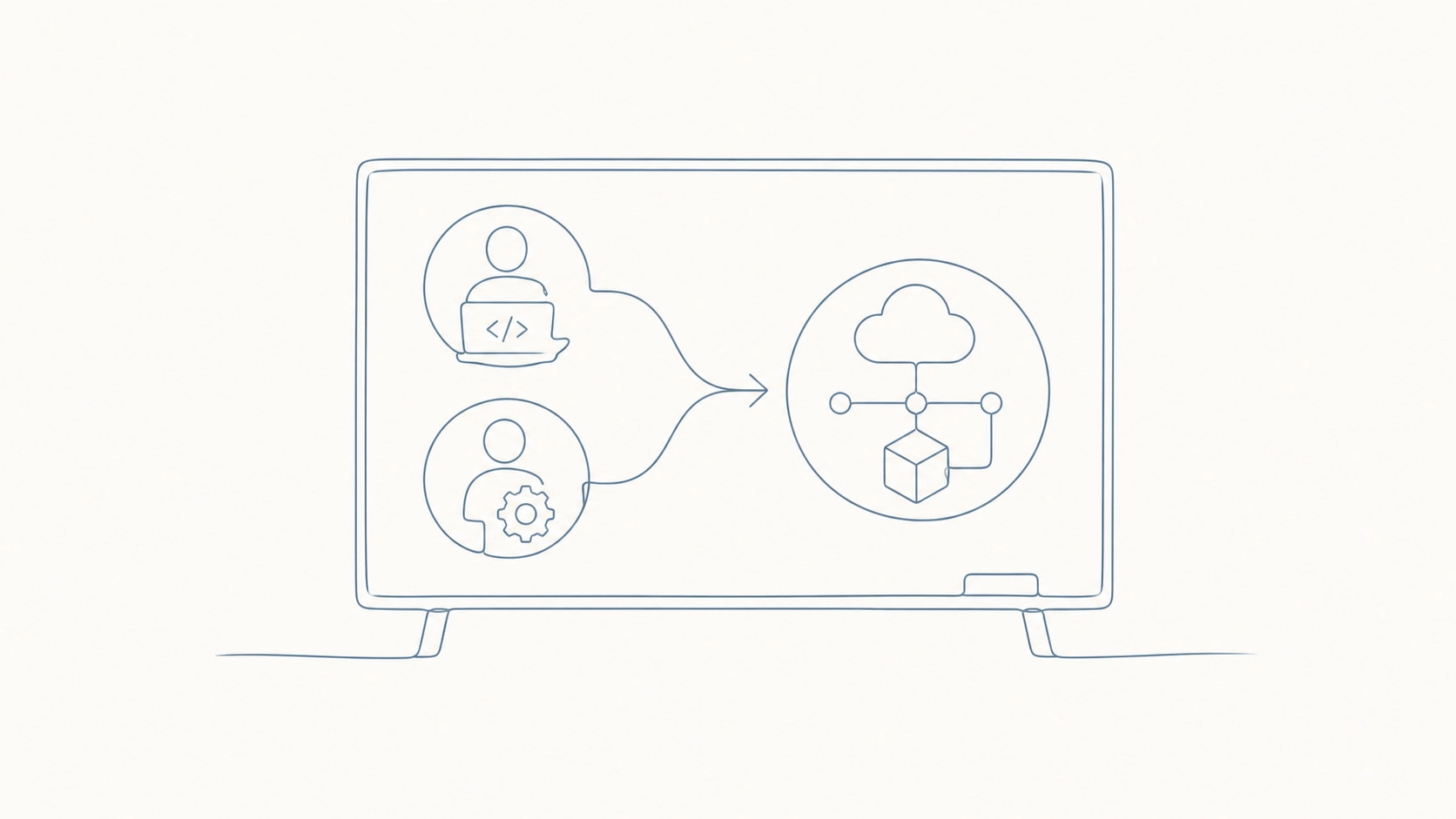
First decide what you are actually hiring for
| Primary problem | Role you probably need | Evidence to ask for |
|---|---|---|
| Manual deployments and inconsistent environments | DevOps / cloud automation engineer | CI/CD design, infrastructure as code and rollback patterns |
| Incidents, weak observability and slow recovery | Site reliability engineer | SLOs, incident response, error budgets and postmortems |
| Developers wait on infrastructure tickets | Platform engineer | Self-service workflows, golden paths and product thinking |
| Cloud spend is growing without ownership | Cloud / FinOps engineer | Cost allocation, capacity planning and optimisation |
| Controls block releases or exist only on paper | DevSecOps engineer | Policy as code, secrets management and supply-chain security |
A startup with one application and a fragile deployment pipeline usually does not need an internal developer platform. A company with twenty teams opening infrastructure tickets probably does. Calling both positions “Senior DevOps Engineer” guarantees a noisy DevOps engineer hiring process.
DevOps engineer, SRE or platform engineer?
DevOps is a way of organising software delivery around shared ownership, automation and fast feedback. An SRE role usually concentrates on production reliability. Platform engineering packages selected DevOps practices into an internal product that developers can use without becoming cloud specialists.
Google Cloud defines an internal developer platform as tools and technologies that abstract technical complexity and enable self-service. DORA’s guidance is equally important: treat the platform as a product, make developers its customers and measure both delivery performance and developer satisfaction.
That means “stop hiring DevOps engineers and build a platform team” is bad universal advice. A platform is justified by repeated organisational friction, not by fashion. Hire one DevOps engineer when one person can remove the current constraint. Build a platform team when the same constraint appears across several product teams and needs a maintained internal product.
If the wider issue is how responsibilities are distributed across the delivery organisation, our guide to functional engineering unit design shows how to define ownership before adding more roles.
Write the scorecard before the job description
A scorecard defines what must be true after six months. It prevents an interview panel from selecting the person with the longest tool list.
For example:
- deployment lead time falls from two days to under two hours;
- every production service has an owner, dashboard and actionable alert;
- new environments are created through version-controlled automation;
- recovery procedures are tested rather than stored in a document;
- cloud cost is attributable by product or environment;
- developers can complete the three most common infrastructure tasks without a ticket.
Choose three outcomes. If the role owns all six on day one, it is probably three positions disguised as one.
The same evidence-first approach applies when evaluating external specialists. Our guide to hiring an ML engineer beyond the résumé explains how to test operating judgment instead of relying on credentials.
Skills that predict performance
Systems reasoning
The candidate should explain failure boundaries, trade-offs and recovery paths. Ask what happens when a deployment succeeds in one region and fails in another, not which command they use.
Software engineering
Infrastructure as code is still code. Look for versioning, tests, review, modular design and maintainability. A folder of scripts owned by one person is not a platform.
Observability and incident learning
A strong engineer distinguishes symptoms from service-level objectives. They should know when an alert deserves to wake someone and how a postmortem changes the system.
Developer empathy
Platform users are product engineers. Good infrastructure reduces their cognitive load without hiding the information needed to debug. The candidate should be able to describe how they collect and prioritise developer feedback.
Security and cost awareness
Least privilege, secret rotation, dependency risk and cost allocation belong in the design. They should not appear as cleanup projects after launch.
Tool familiarity matters after these fundamentals. Kubernetes experience is valuable when you run Kubernetes. It is irrelevant evidence if the best solution is a managed runtime.

If reducing cloud waste is part of the role, use our cloud cost optimization guide to turn that goal into specific responsibilities: allocation, rightsizing, safe rollout and evidence of savings.
A DevOps engineer hiring process that works
- Clarify the constraint. Interview engineering managers and developers. Find the workflow creating the most waiting, risk or repetitive work.
- Create the scorecard. Select three six-month outcomes and define how each will be measured.
- Screen for comparable scale. Cloud names matter less than traffic, team count, compliance and operational maturity.
- Use a system-design scenario. Give candidates a simplified version of a real problem and ask for assumptions, trade-offs, failure handling and rollout.
- Review an artefact. Ask for an anonymised design, postmortem, repository or walkthrough. Evaluate clarity and decisions, not visual polish.
- Include a product engineer. The internal customer should test whether the proposed solution would reduce or add friction.
- Reference-check the operating behaviour. Ask how the candidate handled incidents, disagreement and inherited systems.
A take-home task should be small and paid. Do not ask someone to design your production platform for free.
Interview questions that expose real experience
- Which production alert did you delete, and why?
- Describe an automation you intentionally did not build.
- How would you migrate a deployment pipeline without stopping feature delivery?
- A team requests a new database. What should be self-service, and what still needs approval?
- Which reliability metric would you show the CFO?
- Tell us about a platform feature developers refused to use.
- What must happen before an engineer receives production access?
Good answers contain context, alternatives, an explicit decision and a result. Weak answers collapse into product names.
In-house, contractor, staff augmentation or managed service?
| Model | Best when | Main risk |
|---|---|---|
| Permanent hire | Infrastructure is strategically differentiating and needs long-term ownership | Slow search and dependence on one early hire |
| Contractor | The problem is narrow, temporary and already well specified | Knowledge leaves with the contract |
| Staff augmentation | You have technical leadership but lack specific capacity or experience | You retain architecture and management responsibility |
| Managed cloud / DevOps service | You need an outcome and do not have an internal platform function | Vendor dependence if documentation and access stay outside your team |
Use a permanent hire when this capability will still be central in three years. Use a contractor for a bounded migration. Use staff augmentation when your lead already knows what needs to be built. Use a managed service when you want the provider to own reliability and delivery rather than supply one person.
For wider model and regional rate comparisons, see what it costs to hire a developer in 2026 and our comparison of three ways to hire dedicated developers.
How much does it cost to hire a DevOps engineer?
DevOps rates vary more by location, seniority and engagement model than by title. Powercode Group’s published band is $25–$49 an hour, while the broader verified regional bands in our developer-cost guide range from under $25 in parts of Asia to $100–$300 for US product and agency firms.
Do not compare hourly rates without adding your own management time and the cost of operational mistakes. A senior engineer who removes a recurring release bottleneck can be cheaper than a lower-rate engineer who becomes the new bottleneck.
Ask for these items in every quote:
- named engineer or team composition;
- time-zone overlap and on-call expectations;
- replacement and handover terms;
- ownership of infrastructure, accounts and documentation;
- security responsibilities;
- what is included outside hands-on engineering time.
A 30-60-90 day onboarding plan
Days 1–30: understand and stabilise
Map services, accounts, owners, deployment paths, current incidents and access. Fix urgent security or recovery gaps, but avoid rebuilding the stack before understanding why it exists.
Days 31–60: remove one repeated constraint
Automate the highest-friction workflow from the scorecard. Measure the baseline and the result. This creates credibility and tests whether the proposed platform direction matches developer needs.
Days 61–90: publish the operating roadmap
Define service ownership, SLOs, the next golden paths, cost controls and the work that should remain manual. The roadmap should connect every infrastructure initiative to delivery performance or risk.
Failure modes to avoid
The unicorn description. AWS, Azure, GCP, Kubernetes, networking, security, databases and 24/7 support in one role usually signals that the company has not prioritised.
Tool trivia interviews. They select for memorisation and familiarity with your exact stack, not judgment.
Building a platform before finding users. DORA calls this the “build it and they will come” trap. Start from critical developer journeys and measured friction.
No internal owner. An external engineer can build the capability, but someone inside must own priorities, access and adoption.
Reliability without product trade-offs. Uptime is not free. The business must decide what reliability level the product justifies.
Where we are the wrong choice
If you already have strong infrastructure leadership and only need one permanent strategic owner, hire directly. If the task is a two-week configuration change, a specialist contractor will create less overhead.
We fit when a company needs vetted cloud and DevOps capacity quickly or wants a team to own a defined infrastructure outcome. Powercode Group provides cloud and DevOps engineers, dedicated teams and custom software delivery across EU and UK entities.
Frequently asked questions
How do I hire a DevOps engineer?
Start with the operating problem and three measurable outcomes. Screen for comparable scale, use a real system-design scenario, include a product engineer in the panel and verify incident and handover behaviour in references.
What skills should a DevOps engineer have?
Prioritise systems reasoning, software engineering, infrastructure as code, observability, security, cost awareness and communication. Add cloud and orchestration tools that match your actual environment rather than every popular technology.
When should I hire a platform engineer instead?
Hire for platform engineering when several teams repeatedly need the same infrastructure capabilities and self-service would reduce cognitive load. Do not build an internal platform for one application or one temporary migration.
Should I hire a DevOps engineer or use a managed service?
Hire when the capability is strategic and needs long-term internal ownership. Use a managed service when you need a defined operational outcome and lack the leadership or capacity to build the function immediately.
How much does it cost to hire a DevOps engineer?
Cost depends on region, seniority and model. Powercode Group’s published band is $25–$49 an hour; verified market bands range much more widely. Compare total cost, on-call scope, handover and management overhead rather than rate alone.
What should a DevOps technical interview include?
Use a small system-design exercise based on a real constraint. Evaluate assumptions, failure modes, rollout, security, cost and how developers will use the result. Avoid trivia about commands and product flags.
How long does DevOps hiring take?
A direct permanent search often takes several weeks or longer. At Powercode Group, we work to provide the first matching profiles within five working days. From shortlist to a productive engineer typically takes two to six weeks, depending mainly on onboarding and production-access requirements.
Sources
The platform-engineering definitions and implementation recommendations come from DORA’s platform engineering capability guide, the 2025 State of AI-assisted Software Development report and Google Cloud’s platform engineering guidance.
If you can name the delivery or reliability constraint, send it to us. We will tell you whether it needs a DevOps hire, a platform capability or a short specialist engagement, including when the best option is not Powercode Group.