LLM Routing: Static, Semantic and Dynamic Approaches
LLM routing selects a model or processing path for each request instead of sending every prompt to the same endpoint. Static rules offer control, semantic routing handles recognizable intent, and dynamic routing predicts which model can meet the required quality at an acceptable cost and latency. The right choice depends on your traffic, risk and ability to evaluate the router.

What is LLM routing?
LLM routing is the application-level decision that sends a request to one of several model endpoints, configurations or specialist paths. The router may consider task type, language, risk, context length, expected quality, latency, availability and cost.
This is different from a mixture-of-experts model, where routing happens inside one model. It is also different from ordinary network routing. The page owner here is the software layer that decides which separately served model or path should handle a request.
Routing can improve efficiency, but it creates a new production dependency. If the router is wrong, the best model behind it never receives the request. That is why route quality, fallback behavior and observability deserve the same attention as model quality.
The three main LLM routing approaches
| Approach | Decision signal | Strength | Main limitation |
|---|---|---|---|
| Static or rules-based | Declared rules such as task, tenant, language or risk | Predictable and easy to audit | Rules become brittle as traffic changes |
| Semantic or classifier-based | Intent, similarity or a trained category | Handles varied phrasing without a large rule set | Classification errors can be hard to see |
| Dynamic quality-predictive | Estimated response quality plus cost or latency constraints | Adapts model choice per request | Needs strong evaluation data and a reliable fallback |
1. Static and rules-based routing
A static router uses explicit conditions. Examples include:
- Send translation requests to a multilingual model.
- Use a private endpoint for requests that contain regulated data.
- Route short, low-risk classifications to a smaller model.
- Use a larger context model when the request exceeds a defined token threshold.
- Keep a specific customer or region on an approved provider.
Static routing is often the best first implementation because its behavior is inspectable. Product, security and engineering teams can review the rule set together. It also creates a baseline for measuring whether a more complex router adds value.
The weakness is maintenance. Language changes, models improve and exceptions accumulate. If rules are added without ownership, the router can turn into an undocumented policy engine.
Choose static routing when categories are clear, auditability matters, traffic is moderate, or a small set of rules captures most decisions.
2. Semantic and classifier-based routing
A semantic router maps varied requests to a known route. It may use embeddings, a conventional classifier or an LLM classification step. For example, “I cannot sign in,” “my verification code expired” and “the login link fails” could all map to an account-access route without matching the same keywords.
Anthropic describes routing as a useful workflow when requests fall into distinct categories that can be classified accurately. Its routing pattern also makes the main design obligation clear: the classifier must separate the categories well enough for downstream specialization to help.
Semantic routing is useful when intent is stable but wording varies. It is less suitable when routes overlap heavily, labels are subjective or a wrong route creates a high-impact action. In those cases, add a confidence threshold, a safe default and a human review path.

3. Dynamic quality-predictive routing
A dynamic router estimates which model is likely to produce an acceptable response for the current request. It can choose a smaller model for straightforward inputs and a stronger model when the quality difference is expected to matter.
Amazon Bedrock intelligent prompt routing is a current managed example. AWS documents that the service predicts response quality for supported models and routes for a quality-cost trade-off. AWS also documents important limits: support depends on model family and region, optimization is for English prompts, and the service does not adapt decisions to an application’s own performance data. These constraints show why a managed router still needs application-specific testing.
Dynamic routing is most valuable when requests vary enough that one model is wasteful or insufficient, and when you can build a representative evaluation set. It is a poor shortcut for unclear quality requirements.
How an LLM routing request should flow
A production router needs more than a classifier. A robust request path usually includes:
- Validate the input. Enforce size, format, identity and tenant boundaries before model selection.
- Apply policy constraints. Remove routes that are not permitted for the data, region or action.
- Choose a route. Use a rule, classifier or quality predictor among the remaining options.
- Invoke the selected model. Keep model-specific prompts and parameters versioned.
- Check the result. Validate structure, safety and task-specific acceptance conditions.
- Fallback or escalate. Retry only when useful; otherwise use a baseline model or human path.
- Record the outcome. Log route, latency, cost signal, errors and evaluation result without exposing sensitive content unnecessarily.
The fallback should be part of the design, not a catch-all exception. AWS uses a fallback model as a quality baseline in its configurable routers. Your application may also need a policy fallback, such as refusing an unsupported action instead of calling another model.
How to choose the routing strategy
Assess six variables before selecting a method.
Traffic diversity
If almost every request has the same shape, one model and one prompt may be simpler and more reliable. Routing earns its place when task types, difficulty or constraints differ materially.
Quality threshold
Define what “good enough” means for each route. A customer-facing answer, code change and entity extraction do not share one useful quality metric. Start with task-specific acceptance criteria, then decide whether cheaper routes can meet them.
Cost and latency
Measure end-to-end performance. A smaller model can cost less per call, but a failed route, second call or long classification step can erase the saving. Treat model price as one input to the broader controls described in our cloud cost optimization guide.
Risk and compliance
Some requests should never enter the general routing pool. Data location, contractual restrictions and action risk may determine the eligible models before any quality or cost decision. Review permissions and data flows using our AI agent security checklist.
Change rate
Models, prices and provider limits change. Static rules need review; learned routers need fresh evaluation. A design that works only while one benchmark and one model list remain fixed will age badly.
Team capacity
Routing adds prompts, classifiers, telemetry, evaluation data and fallbacks to maintain. If one model already meets the requirement, operational simplicity may be worth more than a theoretical saving.
Evaluate the router, not only the models
Create a versioned evaluation set from representative, permitted requests. Include common work, costly edge cases, ambiguous inputs and requests that must refuse or escalate. For every case, record the acceptable routes and the task outcome that matters.
Then compare:
- route accuracy by task and risk segment;
- end-task quality after routing;
- p50 and tail latency for the complete request;
- cost per successful task, not only cost per call;
- fallback, retry and escalation rates;
- failure severity, including policy violations;
- behavior after model, prompt or routing-rule changes.
Run a candidate router in shadow mode when possible: calculate the route without using it, then compare its decision with the current production path. Move to a limited rollout only after the result is strong enough for the task. The broader release process in our agent evaluations guide applies even when the system is not an autonomous agent.
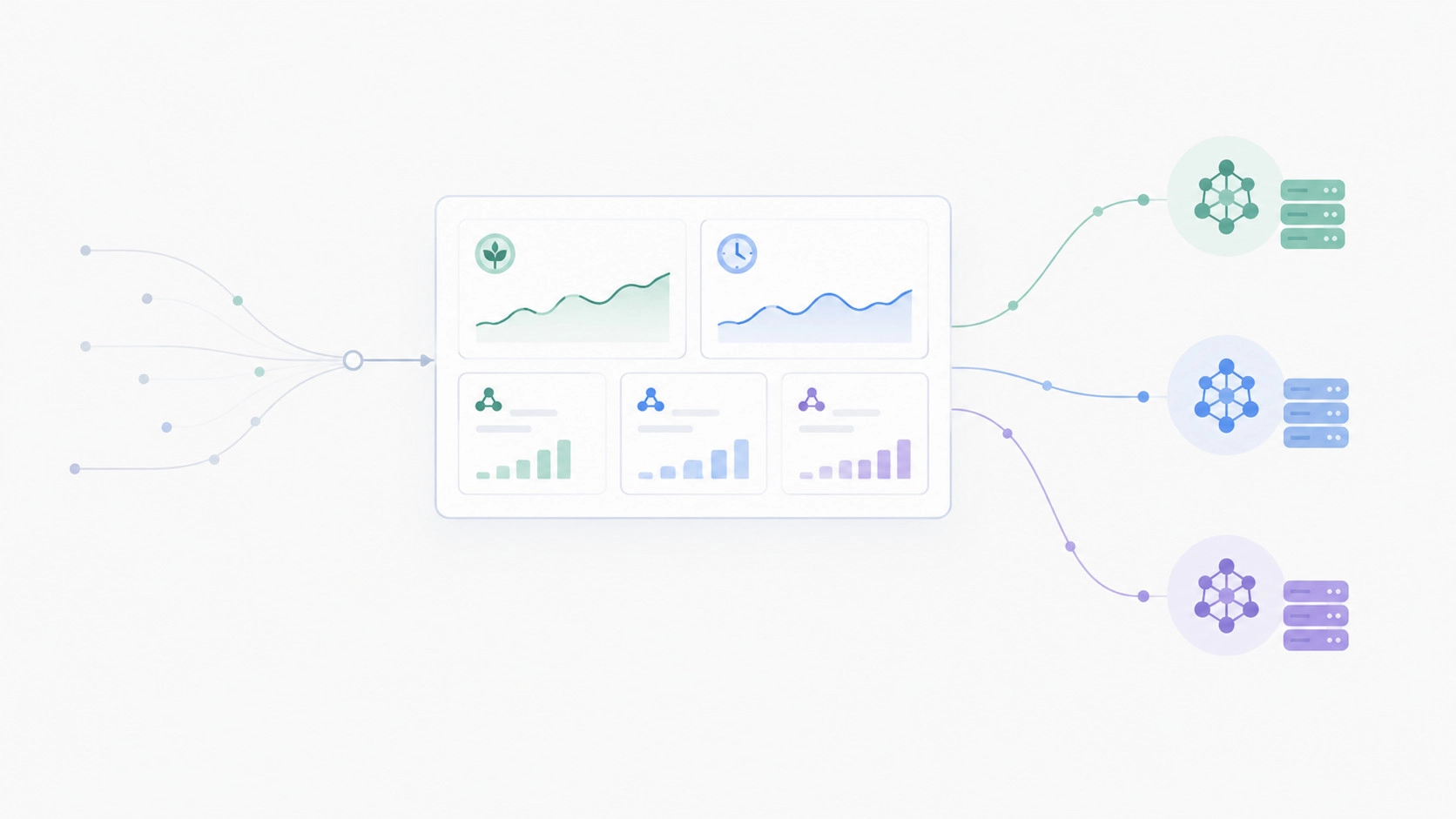
Common routing failures
- Optimizing for price before quality: the cheaper route creates corrections, retries or lost trust.
- Using labels that overlap: the classifier cannot separate routes that the team has not defined clearly.
- Ignoring router latency: a slow classification call removes the benefit of a fast target model.
- No safe fallback: low-confidence requests fail unpredictably or reach an unsuitable model.
- Silent model changes: a provider update changes route quality without triggering regression tests.
- Missing route telemetry: teams see a bad answer but cannot reconstruct why that model was selected.
- Routing secrets by accident: the decision layer receives content it did not need to inspect.
Build, buy or keep one model?
Use a managed router when its model set, regions, controls and evaluation options match your requirements. Build an application-specific router when your categories, policies or quality evidence are unique enough to justify ownership. Keep one model when it already meets the service target and routing complexity would exceed the likely benefit.
The surrounding integration decision also matters. Our Claude integration architecture comparison explains how responsibilities change between a direct API, managed platform and framework.
LLM routing implementation checklist
- Define the eligible models and non-negotiable policy constraints.
- Write task-specific quality thresholds before optimizing cost.
- Establish a one-model baseline.
- Choose the simplest router that can improve that baseline.
- Create a representative, versioned evaluation set.
- Define low-confidence and provider-failure fallbacks.
- Log the route and outcome with privacy controls.
- Test in shadow or limited traffic before full rollout.
- Re-evaluate after model, prompt, price or policy changes.
When routing is worth a proof of concept
Routing is a good candidate when traffic contains clearly different tasks and one model cannot meet all quality, latency and cost targets efficiently. Powercode’s AI & Data Science and custom software development teams can help define the baseline, build a representative evaluation set and test the smallest viable router before a production commitment.
Frequently asked questions
Does an LLM router add latency?
Yes, unless the decision is already available from a cheap rule or cached signal. Measure total request latency, including classification, retries and fallback. A router is useful only when the overall trade-off improves.
Can an LLM route requests to another LLM?
Yes. An LLM can classify intent or assess complexity, but its call adds cost, latency and another failure mode. Compare it with rules, embeddings and conventional classifiers on the same evaluation set.
How do we prevent routing loops?
Keep routing as a single explicit decision where possible. If re-routing is allowed, set a strict attempt limit, record the previous routes and use a terminal fallback. A model should not be able to bounce a request indefinitely.